

Let these works stand as a constant reminder that not all sacrifices are made on the battlefield
The American Civil War is often remembered through battlefield names, military leaders and defining moments of national struggle. Gettysburg, Antietam, Fredericksburg and Appomattox all hold an important place in the American story. Yet behind every campaign were men and women whose lives were changed not only by battle, but by separation, uncertainty and loss.
For soldiers leaving home, the war meant more than marching orders. It meant saying goodbye to wives, sweethearts, families and familiar places, often without knowing if they would ever return. For those left behind, the war was measured in letters, newspaper reports, rumors from the front and the long wait for word from loved ones.
Dale Gallon is best known for his historically detailed Civil War artwork, but his paintings are not limited to the smoke and movement of battle. In several works, Dale turns his attention to quieter moments — the emotional pauses before war resumes, the promises made before parting and the human cost carried by those far from the battlefield.
This collection brings together four Dale Gallon pieces connected by love, devotion and farewell during one of America’s most difficult chapters.
Love, Duty and Separation
The Civil War divided a nation, but it also separated households. Soldiers left farms, cities, colleges and churches to serve in armies that moved across the country. Many carried letters, photographs and personal reminders of the people waiting for them at home. These small connections mattered deeply. In a war filled with danger and uncertainty, a letter from home could steady a soldier’s spirit, while a letter from the front could bring comfort to families waiting miles away.
Romance during the Civil War was not sentimental in the easy sense. It was often marked by absence. Couples were forced to build and preserve relationships through written words, brief meetings and difficult farewells. Some returned home and rebuilt their lives. Others became part of the war’s permanent sorrow.
That emotional world gives this collection its power. These paintings do not turn away from the war. Instead, they remind us that the Civil War was lived by individuals — husbands, wives, fiancées, sweethearts and families — each facing the conflict in deeply personal ways.
Erin’s Pride
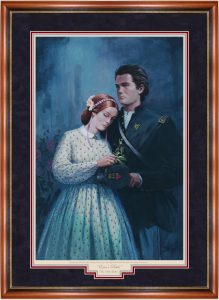
Dale Gallon’s Erin’s Pride shows an officer of the 69th New York Infantry Regiment of the Irish Brigade bidding farewell to his sweetheart before reporting back to the front.
The 69th New York was one of the most famous Irish-American units in the Union Army. It formed part of the Irish Brigade, a group of regiments known for courage, sacrifice and a strong sense of ethnic pride. Many of the men who served in these units were Irish immigrants or sons of Irish immigrants who saw service in the Union Army as both a duty to their adopted country and a statement of identity.
In Dale’s painting, the focus is not the charge of a brigade or the clash of armies. Instead, it is the moment before departure. The officer’s uniform tells us where he is going. The farewell tells us what he is leaving behind.
That tension gives Erin’s Pride its emotional weight. The soldier belongs to a proud regiment, but he is also a man stepping away from someone he loves. His duty calls him back to war, while the woman beside him represents the home and future he hopes to see again.
The Irish Brigade fought in some of the Army of the Potomac’s most difficult campaigns. Its reputation was earned at a terrible cost. Seen through that history, the farewell in Erin’s Pride becomes more than a private goodbye. It stands for thousands of similar moments repeated throughout the war — moments when love, fear, pride and duty all met at once.
Farewell Rose
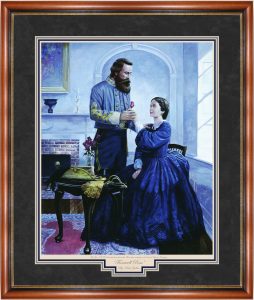
Dale Gallon’s Farewell Rose depicts Major General J.E.B. Stuart bidding farewell to his wife, Flora, at Dundee Plantation near Hanover Courthouse, Virginia, on August 15, 1862, before leaving for the Second Manassas Campaign.
Stuart is often remembered as one of the Civil War’s most colorful cavalry commanders. His image is usually tied to movement, daring raids, plumed hats and battlefield reputation. Yet in Farewell Rose, Dale turns away from the public image of the general and focuses instead on a deeply personal moment between husband and wife.
The scene captures a familiar Civil War theme: the private goodbye before public duty resumes. Stuart’s military career would take him back into the uncertainty of campaign and battle, while Flora remained behind, facing the fear and waiting shared by so many spouses during the war.
That contrast gives Farewell Rose its place in this collection. Like Erin’s Pride, it centers on the act of farewell. Like Joshua & Fanny, it reminds us that famous military figures were also husbands with families and lives beyond the battlefield. And like Last Promise, it carries the shadow of what war could take from those who loved the men who served.
The rose in the title gives the work an especially tender quality. It suggests affection, memory and the fragility of the moment. Dale’s painting does not need a battlefield to show the cost of the Civil War. The emotion is found in the pause before departure, when love and duty stand side by side.
Joshua & Fanny
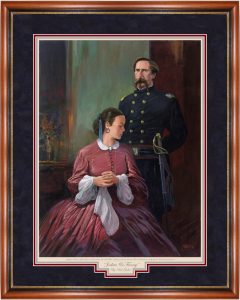
Dale Gallon’s Joshua & Fanny depicts Lt. Colonel Joshua Lawrence Chamberlain of the 20th Maine Infantry with his wife, Caroline Frances “Fanny” Chamberlain, shortly before he leaves for the front.
Joshua Chamberlain is remembered today as one of the most recognizable Union officers of the Civil War. His defense of Little Round Top at Gettysburg became one of the most studied actions of the battle, and his later role at Appomattox placed him near the closing scene of the war. But before all of that, Chamberlain was a husband, father, professor and private citizen who made the decision to enter military service.
That decision came with a personal cost. Like so many Civil War families, Joshua and Fanny Chamberlain endured long periods of separation. Their relationship continued through letters, distance and uncertainty. For Fanny, the war was not an abstract military struggle. It was the absence of her husband and the constant possibility that each goodbye might be final.
This is the strength of Dale’s composition. Joshua & Fanny does not show Chamberlain at the height of fame. It shows the moment before history claims him. The viewer sees a couple standing at the edge of separation, with the future still unknown.
The painting also helps humanize a figure often remembered primarily through battlefield heroics. Chamberlain’s courage at Gettysburg matters, but so does the personal life behind the uniform. By including Fanny in this scene, Dale reminds us that the sacrifices of war extended beyond those who marched and fought.
Last Promise
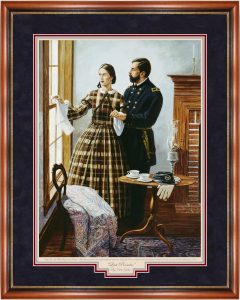
Dale Gallon’s Last Promise tells one of the most poignant love stories connected to Gettysburg. The painting shows Brigadier General John Fulton Reynolds and Catherine Mary Hewitt in Philadelphia in September 1861, entering into a secret engagement before Reynolds reports to the Army of the Potomac.
Reynolds was one of the Union Army’s most respected officers. On July 1, 1863, during the opening day of the Battle of Gettysburg, he was killed while bringing the First Corps into position near McPherson Ridge. His death was a major loss to the Union Army, and he became the highest-ranking officer killed at Gettysburg.
The personal story connected to Reynolds gives Last Promise its lasting emotional pull. Catherine Mary Hewitt, often referred to as Kate, was tied to Reynolds through a secret engagement. According to the traditional account, she promised not to marry if he were killed. After Reynolds died at Gettysburg, she entered religious life.
That story gives the painting its title and its tragedy. A promise made before war becomes a promise shaped by death. The scene is quiet, but the viewer knows what history will bring. Reynolds will not survive Gettysburg. Kate’s life will be changed by his loss. Their private farewell becomes part of the larger sorrow of the Civil War.
Last Promise is especially powerful because it connects the battlefield and the home front so directly. Reynolds’ death is remembered as a military event, but Dale’s painting asks the viewer to consider the personal grief that followed it. The general killed at Gettysburg was also someone loved, mourned and remembered.
The Human Side of Civil War Art
Together, these three works offer a different view of the Civil War. They are not centered on victory or defeat. They do not ask the viewer to study troop movements or battlefield formations. Instead, they invite us to pause with the people who lived in the shadow of the war.
- Erin’s Pride captures the farewell of an Irish Brigade officer returning to duty.
- Farewell Rose shows J.E.B. Stuart saying goodbye to his wife, Flora, before leaving for the Second Manassas Campaign.
- Joshua & Fanny shows Joshua Lawrence Chamberlain and his wife before the war pulls them apart.
- Last Promise remembers the secret engagement of John Reynolds and Kate Hewitt before Gettysburg turns love into loss.
Each painting is rooted in history, but each one also reaches beyond dates and military events. They speak to the private experiences that surrounded the war: devotion, waiting, uncertainty, grief and remembrance.
That is what makes The Romance of the Civil War a meaningful collection. The word “romance” here does not soften the war or make it less tragic. Instead, it points to the emotional lives of the people caught within it. Love did not stop because the country was at war. In many cases, war made love more urgent, more fragile and more deeply remembered.
Dale Gallon’s Romance of the Civil War Collection
Dale Gallon’s historical artwork is known for accuracy, atmosphere and storytelling. In these three pieces, that storytelling becomes especially intimate. The details of uniform, place and historical setting remain important, but the emotional center is found in the people themselves.
These are Civil War images for collectors who are drawn not only to military history, but to the personal stories behind it. They remind us that the war was fought by individuals with homes, relationships and promises of their own.
Through Erin’s Pride, Farewell Rose, Joshua & Fanny and Last Promise, Dale Gallon gives us a Civil War collection centered on love and loss — a reminder that America’s defining conflict was experienced not only on the battlefield, but in the hearts of those who waited, hoped and remembered.
