
Abraham Lincoln’s life began far from the halls of power. Born in Kentucky in 1809, he grew up in a frontier family that later moved to Indiana and Illinois. The Library of Congress notes that Lincoln had only limited formal schooling, but he read widely, worked a variety of jobs, served briefly in the Illinois militia during the Black Hawk War, and eventually built a career as a lawyer and public figure in Illinois.
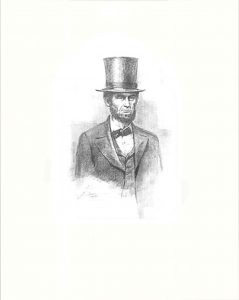
Dale Gallon’s “Lincoln Sketch” offers a quiet portrait-style introduction to the man himself. The piece is an open edition black and white pencil sketch, making it a natural visual starting point for this history page before the story moves toward Lincoln’s presidency and his visit to Gettysburg.
Lincoln entered national politics at a time when the United States was being pulled apart by the question of slavery. He served one term in the U.S. House of Representatives, returned to law and politics in Illinois, and gained national attention during the Lincoln-Douglas debates of 1858. Two years later, he was elected the 16th president of the United States, and his election helped trigger the secession crisis that led to the Civil War.
By 1863, Lincoln was no longer simply trying to preserve the Union as it had been. The war had become tied to the future of slavery itself. On January 1, 1863, Lincoln issued the Emancipation Proclamation, which declared enslaved people in the rebellious states to be free. The National Archives explains that the proclamation did not end slavery everywhere, but it transformed the character of the war, added moral force to the Union cause, and allowed Black men to serve in the Union Army and Navy.
From Union to freedom
The Emancipation Proclamation did not end slavery across the entire country, but it changed the Civil War from a fight only to preserve the Union into a war that also carried the cause of freedom.
The Road to Gettysburg
The Battle of Gettysburg was fought from July 1–3, 1863, and became one of the defining battles of the Civil War. The Union victory stopped Robert E. Lee’s second invasion of the North, but the battlefield was left scarred by immense loss. In the months that followed, local attorney David Wills helped organize a new national cemetery where Union dead could be properly buried and honored.
Wills formally invited Lincoln to attend the dedication. The Library of Congress preserves the text of Wills’s invitation, in which he asked the president to take part in the cemetery dedication and offer “a few appropriate remarks.” Lincoln was not the main speaker that day. That role belonged to Edward Everett, one of the most famous orators in the country. Lincoln’s assigned part was brief, almost secondary in the printed program, but history would remember it differently.
The timing matters. Lincoln was coming to Gettysburg only months after the battle, during a war that was still very much undecided. The dead were still being reburied. Families were still grieving. Soldiers were still fighting. The dedication of the cemetery was not only a public ceremony, but a national act of mourning and meaning.
Lincoln Arrives in Gettysburg — November 18, 1863
President Lincoln arrived in Gettysburg on the evening of November 18, 1863. The National Park Service notes that he was escorted to the David Wills House, where he stayed the night before the cemetery dedication. The David Wills House now interprets the events of Lincoln’s visit, including his arrival, his overnight stay, and the address he delivered the following day.
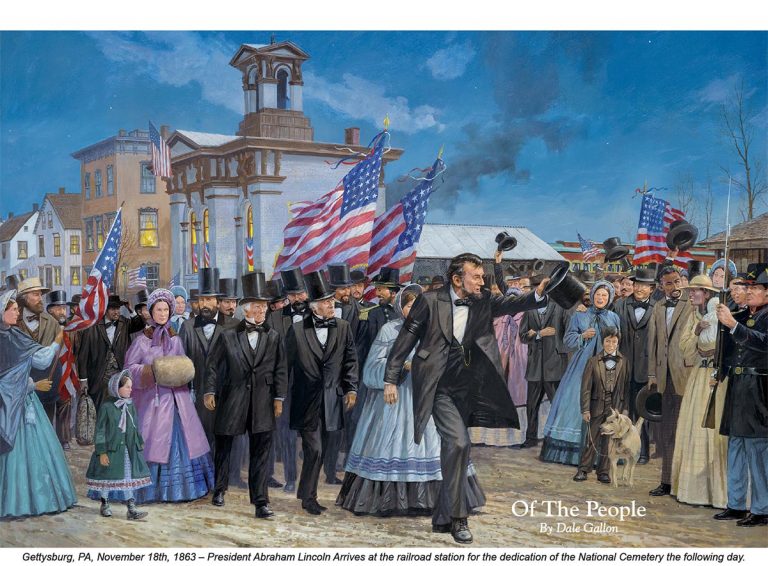
This is the moment Dale Gallon’s “Of The People” brings to life. The painting illustrates Lincoln’s arrival at the Gettysburg railroad station on November 18, 1863, the evening before the dedication of the National Cemetery. The work was released in 2008 and created to commemorate both the 200th anniversary of Lincoln’s birth and the 145th anniversary of the Gettysburg Address.
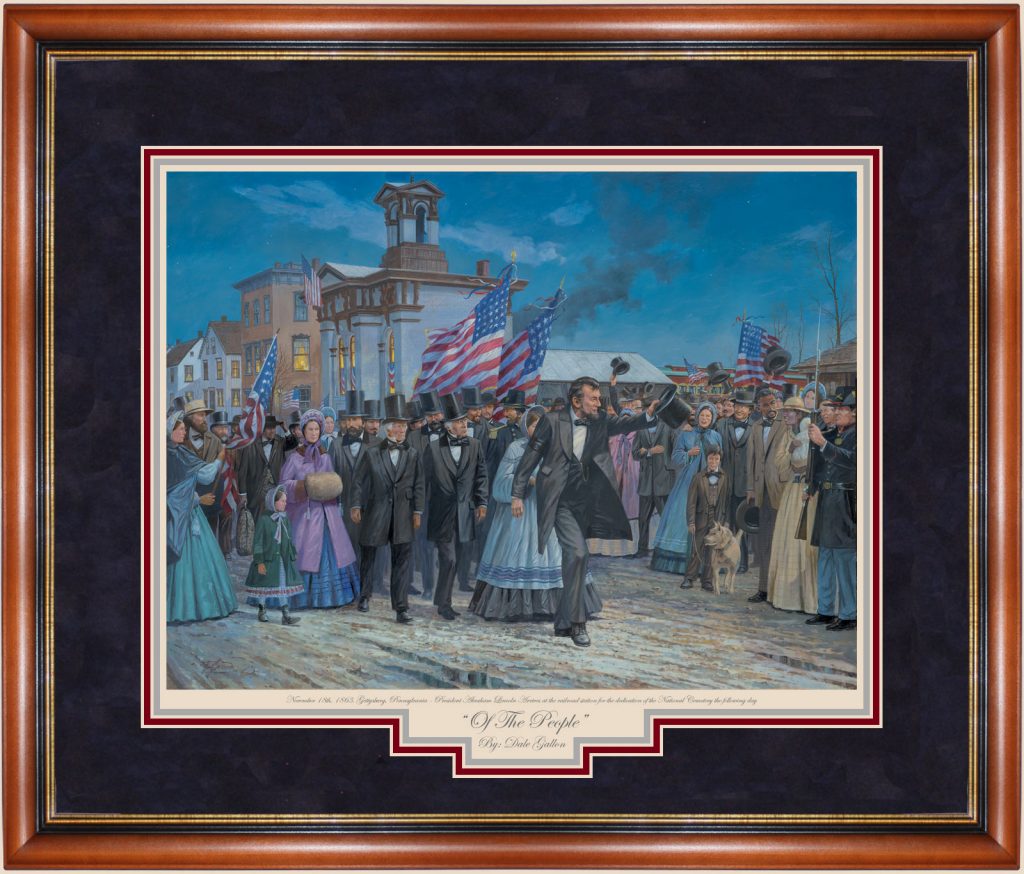
Lincoln’s arrival was not a grand military victory parade. It was quieter, heavier, and more solemn. He came to a town still living with the aftermath of battle. Streets, homes, churches, farms, and fields had all been touched by the fighting. The cemetery dedication was meant to honor the Union dead, but Lincoln’s presence gave the occasion a larger national weight.
Dale’s painting helps visitors pause on that often-overlooked evening: the moment before the famous speech, before the remembered words, before “Gettysburg Address” became one of the most recognizable phrases in American history. It shows Lincoln not as a marble monument, but as a living president arriving in a wounded town during a wounded war.
The night before the address
Lincoln arrived in Gettysburg on November 18, 1863, and stayed at the David Wills House before speaking at the cemetery dedication the next day.
The Gettysburg Address — November 19, 1863
On November 19, 1863, thousands gathered for the dedication of the Soldiers’ National Cemetery. Edward Everett delivered the main address, a lengthy oration that fit the expectations of the time. Lincoln followed with remarks that lasted only about two minutes. The National Park Service notes that approximately 15,000 people were present, and that Lincoln’s speech was over before many in the crowd realized it had fully begun.
Yet Lincoln’s brief remarks gave the day its lasting meaning. He connected the sacrifice at Gettysburg to the founding promise of the United States, the survival of democratic government, and what he called a “new birth of freedom.” The Library of Congress preserves versions of the Gettysburg Address, including printed and manuscript copies tied to the speech’s history and transmission.
The power of the speech came partly from its restraint. Lincoln did not try to describe every movement of the battle or list every sacrifice. Instead, he used the cemetery dedication to ask whether the nation could endure, whether the dead had died in vain, and whether government “of the people, by the people, for the people” could survive the crisis of civil war.
This is why the Gettysburg Address belongs so naturally on a Gallon history page. Dale’s “Of The People,” focuses on Lincoln’s arrival, but the scene points directly toward the next day’s address. The artwork captures the threshold moment: Lincoln entering Gettysburg before giving words that would reshape how Americans understood the Civil War, the Union, and the meaning of national sacrifice.
A short speech with enormous weight
Edward Everett spoke for roughly two hours at the cemetery dedication. Lincoln’s remarks lasted only about two minutes, yet they became one of the most remembered speeches in American history.
After Gettysburg
The Gettysburg Address did not end the war. The fighting continued for more than a year after Lincoln left Pennsylvania. In 1864, Lincoln faced reelection while the war dragged on, casualties mounted, and the outcome remained uncertain. His victory in that election helped confirm that the Union would continue the war until victory rather than negotiate a peace that preserved the Confederacy.
Lincoln’s second inaugural address in March 1865 carried a different tone from the Gettysburg Address. By then, the Confederacy was collapsing, but Lincoln did not speak with triumphal revenge. He spoke of national guilt, suffering, mercy, and the need to bind up the nation’s wounds. Just weeks later, on April 9, 1865, Robert E. Lee surrendered to Ulysses S. Grant at Appomattox Court House.
The end of the war came close enough for Lincoln to see Union victory, but not long enough for him to guide the peace. On April 14, 1865, John Wilkes Booth shot Lincoln at Ford’s Theatre in Washington, D.C. Ford’s Theatre records that Lincoln was attending a performance of Our American Cousin that night; he died the following morning, April 15, 1865.
Lincoln’s Legacy
Abraham Lincoln’s legacy is immense because his presidency stood at the center of the nation’s greatest crisis. He preserved the Union, issued the Emancipation Proclamation, helped move the country toward the permanent abolition of slavery, and gave language to the meaning of sacrifice at Gettysburg. His death transformed him into a martyr, but his importance does not rest on tragedy alone.
Lincoln’s imprint remains because he forced the country to confront what the United States claimed to be. At Gettysburg, he tied the Civil War to the nation’s founding ideals and argued that the dead had given their lives so democratic government might endure. At the end of the war, he urged reconciliation without forgetting the moral cost of slavery and rebellion.
Through “Lincoln Sketch” and “Of The People,” Dale Gallon’s artwork gives visitors two different ways to approach Lincoln: first as the recognizable face of American leadership, and then as a living president arriving in Gettysburg on the eve of one of the most consequential speeches in United States history.