
On June 30, 1863, Gettysburg was still a quiet Pennsylvania crossroads town. No general had selected it as the place where the campaign would be decided. Yet by the end of the day, Confederate infantry was gathered west of town at Cashtown, Union cavalry had arrived from the south, and both armies were moving toward the same network of roads.
The Battle of Gettysburg did not begin with a grand plan to fight at Gettysburg. It developed through marching columns, incomplete reports, scouting, terrain, and decisions made by officers who could not yet see the full picture. June 30 was the day that the wider Gettysburg Campaign narrowed toward one small town—and the day John Buford recognized that the ground around Gettysburg might soon matter enormously.
A New Commander on the Eve of Battle
George G. Meade was named commander of the Army of the Potomac on June 28, 1863, only two days before Union and Confederate forces began converging near Gettysburg.
A Campaign Moves North
After the Confederate victory at Chancellorsville in May 1863, General Robert E. Lee led the Army of Northern Virginia north through Maryland and into Pennsylvania. The movement carried the war out of Virginia, placed Confederate forces in Northern territory, and forced the Army of the Potomac to move north in response.
The Union army followed while remaining between Lee and Washington, D.C. Meade’s army was moving north from Maryland, while Lee’s forces were spread across parts of south-central Pennsylvania. By June 30, Major General Henry Heth’s Confederate division was positioned along the Chambersburg Pike near Cashtown, roughly nine miles west of Gettysburg. At the same time, Brigadier General John Buford’s Union cavalry division was approaching Gettysburg from the south.
Neither side fully understood how close the other army had come. Confederate cavalry under J. E. B. Stuart was still away from Lee’s main army, limiting the intelligence available to Confederate headquarters. Union cavalry, meanwhile, had been tasked with screening the army’s movement and locating Confederate forces.
Gettysburg and the Roads That Led There
Gettysburg was not a major military objective before the battle, but it was an important transportation hub. Roads ran outward toward Chambersburg, Carlisle, York, Harrisburg, Baltimore, Emmitsburg, Taneytown, and the surrounding countryside. Those roads could carry infantry columns, artillery, wagons, couriers, scouts, and reinforcements in nearly every direction.
For both armies, control of those routes mattered. A force arriving first could receive information sooner, move troops more quickly, and choose ground before the enemy did. Meade directed Buford to occupy Gettysburg, scout the countryside, and help secure the crossroads for the advancing Union army.
Ten Roads Met at Gettysburg
Gettysburg’s strategic importance came from its road network. Ten roads met in and around the town, connecting it to the surrounding Pennsylvania and Maryland countryside.
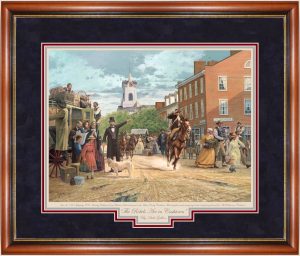
While generals studied maps and couriers carried reports, Gettysburg’s residents faced the more immediate uncertainty of hearing that Confederate troops were close by. Dale Gallon’s “Rebels are in Cashtown,” released in 2013 as part of the Seminary Ridge Museum Series, places the story on Baltimore Street near the town square.
The work looks south toward the Adams County Courthouse and uses the reported presence of Confederate troops at Cashtown as the source of its tension. Dale’s scene shifts the viewer away from headquarters and marching columns to the people of Gettysburg, who could not know that their town was about to become the center of a battle that would change their community forever.
A Confederate Reconnaissance from Cashtown
On the morning of June 30, Heth sent Brigadier General James J. Pettigrew’s brigade east toward Gettysburg to investigate the town and look for supplies. Pettigrew’s men moved toward Gettysburg but found Union cavalry near the town. Uncertain of the size of the force in front of him, Pettigrew did not attempt to force his way into Gettysburg. Instead, he withdrew and returned to Cashtown with his report.
That report was important because it told Confederate commanders that Federal troops were in the area. Heth passed the information to Lieutenant General A. P. Hill, commander of the Confederate Third Corps. The Confederates still did not understand the full strength or location of the Army of the Potomac, but the next morning Heth’s division would move east again along the Chambersburg Pike.
Pettigrew Found Union Cavalry
Heth’s report stated that Pettigrew encountered a large force of cavalry near Gettysburg and withdrew rather than enter the town with a single brigade.
The Eyes of the Army of the Potomac
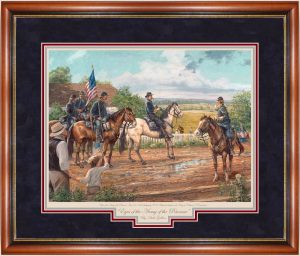
Buford’s cavalry division reached Gettysburg from the south on June 30. His troopers were not simply riding ahead of the Union army. They were its eyes: watching roads, gathering reports, locating enemy forces, and sending information back to commanders who needed to decide where to concentrate their troops.
Dale’s “Eyes of the Army of the Potomac,” released in 2013, illustrates Buford being briefed by his scouts about Confederate troop dispositions. The work emphasizes the intelligence side of the approaching battle. Before the armies could fight, commanders had to learn where the enemy was, what roads he controlled, and how quickly he might move.
Buford’s reports helped give Meade a clearer sense of the Confederate position. Just as importantly, Buford could see that the ridges and roads around Gettysburg offered ground the Union army might be able to use—provided the Confederates could be delayed long enough for Union infantry to arrive.
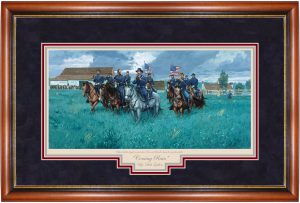
Gallon’s panoramic “Coming Rain,” released in 2000, places Buford with brigade commanders Thomas Devin and William Gamble at McPherson’s Farm. The title reflects the tension of the moment. The men were not yet standing in a battlefield filled with gunfire, but the signs of an approaching clash were becoming difficult to ignore.
The painting provides a visual pause before the fighting begins: officers on horseback, open ground, roads stretching west toward Cashtown, and the knowledge that Confederate infantry was nearby. It is the quiet before Gettysburg became Gettysburg.
A Heavy Task Before Us
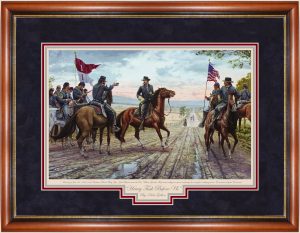
Buford did not have enough cavalry to defeat a large Confederate infantry force in open battle. His role was to observe the approaching enemy, contest the roads west of town, and gain time for the Army of the Potomac’s infantry to come forward. It was a delaying mission, but a delay measured in hours could determine which army reached the strongest ground first.
The terrain around Gettysburg shaped that decision. The rolling ground west of town could slow an advance, while the ridges south of town offered the Union army a potentially strong position once enough troops arrived. Buford understood that abandoning Gettysburg too quickly would leave the Confederates free to seize the crossroads and high ground without opposition.
Dale Gallon’s “Heavy Task Before Us,” released in 1992 and commissioned by the Command and General Staff College at Fort Leavenworth, depicts Buford meeting Colonel William Gamble along the Cashtown Road on the evening of June 30.
The work represents the essential decision of the night. Buford and his command were preparing to meet the Confederates west of Gettysburg and hold as long as possible. The cavalry could not know exactly how the next day would unfold, but they knew the enemy was near, that the roads mattered, and that the Union infantry needed time.
Buford Chose to Stay
After encountering the head of a Confederate column on June 30, John Buford decided to remain near Gettysburg overnight and wait for the Confederates to return the following day.
Night Falls Before the Battle
By nightfall on June 30, neither Lee nor Meade had committed his entire army to battle at Gettysburg. Confederate commanders knew Union cavalry was near town but did not yet grasp how close the larger Union army had come. Union commanders knew Confederate forces were nearby, but they could not yet know where the opening blow would fall or how quickly the fighting would grow.
On the morning of July 1, Heth’s Confederate division would march east from Cashtown along the Chambersburg Pike. Buford’s cavalry would be waiting west of Gettysburg. The first shots would begin as a contest for roads and ground, but the encounter would quickly expand into the opening day of the Battle of Gettysburg.
Next in the story: Battle of Gettysburg: Day 1 follows the opening shots west of town, Buford’s delaying action, and the arrival of Union infantry under General John Reynolds.
See the Three Days of Gettysburg in One Framed Work

June 30 was only the beginning. Over the next three days, Gettysburg became the setting for some of the Civil War’s most remembered Union and Confederate actions.
For Gettysburg visitors, Civil War collectors, and anyone who wants to keep the full story together, it is a meaningful way to display Dale Gallon’s interpretation of the battle’s three defining days.
“3 Days of Gettysburg” brings the larger story together in one 41″ x 27″ framed work. The piece presents six mini images: one Union and one Confederate scene from each day of the battle, creating a single visual history of July 1, July 2, and July 3, 1863.