
The American Revolutionary War began as a struggle over the authority of Parliament and the rights of Britain’s North American colonies. After the French and Indian War ended in 1763, the British government imposed new taxes and tighter imperial controls to help pay the costs of empire. Measures such as the Stamp Act, the Townshend Acts, and the Coercive Acts deepened colonial resistance and helped turn arguments over representation into a broader debate over liberty and self-government.
Open warfare erupted at Lexington and Concord on April 19, 1775. The Second Continental Congress created the Continental Army and placed George Washington in command, but independence was not yet the universally accepted goal. That changed during the following year as the conflict widened, Thomas Paine’s Common Sense reached a mass audience, and the Continental Congress adopted the Declaration of Independence on July 4, 1776.
Declaring independence was one thing; securing it was another. The new United States faced the military power of Great Britain with an army that repeatedly struggled for men, supplies, training, and money. Dale Gallon’s Revolutionary War paintings enter that larger story at six critical moments—moments of decision, local resistance, disciplined assault, and battlefield endurance that carried the American cause from the desperate winter of 1776 into the decisive Southern Campaign of 1781.
From Colonial Rebellion to a Global War
The Revolutionary War began in 1775 as a conflict between Great Britain and its North American colonies. By its conclusion, it had expanded into a global struggle involving European powers and their empires.
Christmas Night on the Delaware
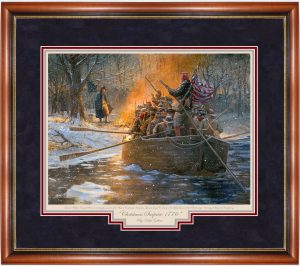
By December 1776, the Revolution was in danger. Washington’s army had been driven from New York, retreated across New Jersey, and crossed the Delaware River into Pennsylvania. Enlistments were nearing expiration, supplies were scarce, and British and Hessian forces occupied a chain of posts across New Jersey. A passive winter could have allowed the Continental Army to dissolve.
Washington instead planned a night crossing and a surprise attack against the Hessian garrison at Trenton. On Christmas night, soldiers, horses, artillery, and wagons moved through darkness, wind, sleet, and floating ice. The crossing took longer than expected, but Washington pressed forward. The victory at Trenton on December 26—and the operations that followed at Assunpink Creek and Princeton—restored confidence in the army and proved that the Revolution had survived its most dangerous year.
Dale Gallon’s “Christmas Surprise 1776” places Washington at McConkey’s Ferry before the attack. Rather than repeat the bright, heroic image made famous by Emanuel Leutze’s nineteenth-century painting, Dale’s work emphasizes the uncertainty of the real crossing: night, severe weather, working river craft, and a commander contemplating a decision on which the future of the army might depend.
The Marbleheaders Carried an Army Across
Colonel John Glover’s Marblehead soldiers ferried approximately 2,400 troops, along with horses, artillery, and wagons, across the Delaware under extreme weather conditions on the night of December 25, 1776.
Citizen Soldiers at Ridgefield
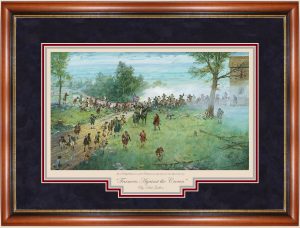
The victory at Trenton did not end Britain’s ability to strike deep into Patriot territory. In April 1777, Major General William Tryon led more than 1,800 British and Loyalist troops from the Connecticut coast toward Danbury, where large quantities of Continental supplies had been stored. The raiders destroyed military provisions and burned buildings before beginning their march back toward their ships.
News of the raid brought local militia and nearby Continental soldiers into motion. Generals David Wooster, Gold Selleck Silliman, and Benedict Arnold organized resistance along the British route. Wooster was mortally wounded while attacking the rear of the column. At Ridgefield, Arnold and several hundred defenders prepared a barricade across the road and confronted a force far larger and more experienced than their own.
Released in 2021, Dale’s “Farmers Against The Crown” shows the struggle at the Ridgefield barricade on April 27, 1777. The painting focuses not on a formal Continental battle line, but on hastily assembled defenders resisting veteran British regulars. It captures one of the Revolution’s defining realities: the war depended not only on Washington’s main army, but also on communities willing to mobilize when the conflict reached their roads, farms, and homes.
Connecticut’s Only Inland Revolutionary War Battle
The Battle of Ridgefield was part of the British expedition against Danbury and became the last attempted inland invasion of Connecticut by the British army during the war.
Saratoga, France, and a Wider War
The campaigns of 1777 brought both suffering and opportunity. British forces captured Philadelphia, and Washington’s army entered winter quarters at Valley Forge. In northern New York, however, an American army forced the surrender of Lieutenant General John Burgoyne at Saratoga. That victory demonstrated that the United States could defeat a major British field army and gave American diplomats the leverage they needed in Europe.
France formally allied with the United States in 1778, bringing military supplies, loans, soldiers, and naval power into the struggle. Britain now had to defend interests across the Atlantic, the Caribbean, the Mediterranean, Africa, and India. The Revolution was no longer only a war along the eastern edge of North America; it had become part of a worldwide imperial conflict.
The French Alliance Changed the War
The United States and France signed treaties of amity, commerce, and military alliance in February 1778. French recognition and assistance transformed the diplomatic and military balance of the Revolution.
The Midnight Assault at Stony Point
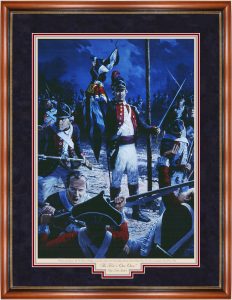
In 1779, the war around New York had settled into a dangerous contest over the Hudson River. British forces captured Stony Point and the nearby King’s Ferry crossing, strengthening the rocky peninsula with artillery, earthworks, and obstacles. The position guarded an important route between New England and the other states and appeared difficult to approach, much less storm.
Washington approved a night assault led by Brigadier General Anthony Wayne and a specially organized corps of light infantry. To preserve surprise, the principal attacking columns advanced with unloaded muskets and fixed bayonets. Shortly after midnight on July 16, they crossed marshy ground, broke through the defenses, and overwhelmed the garrison in a rapid close-quarters attack.
Dale’s “The Fort’s Our Own,” released in 1998, centers on Lieutenant Colonel François de Fleury, the French-born engineer who commanded part of the attacking force. De Fleury was among the first Americans into the works and seized the British colors. The painting preserves the instant when planning, engineering skill, surprise, and individual courage converged inside the captured fort.
Stony Point Fell in the Darkness
American light infantry stormed Stony Point shortly after midnight and captured the fort at approximately 1:00 a.m. The victory disrupted British plans along the Hudson and gave the American army a badly needed morale boost.
The War Moves South
As fighting in the North reached a stalemate, British strategy increasingly focused on the South. British leaders hoped to secure Georgia and the Carolinas, mobilize Loyalist support, restore royal authority, and then drive northward. Savannah fell in 1778, Charleston surrendered in 1780, and the American defeat at Camden appeared to place the Southern cause in grave danger.
Washington selected Major General Nathanael Greene to rebuild the Southern Department. Greene understood that preserving his army mattered more than holding every battlefield. He divided his forces, stretched British supply lines, encouraged partisan resistance, and forced Cornwallis into an exhausting pursuit across the Carolinas. The American victories at Kings Mountain and Cowpens weakened British strength before Greene finally chose ground on which to fight at Guilford Courthouse.
A Southern Strategy Began to Unravel
Kings Mountain, Cowpens, and Guilford Courthouse formed a succession of reverses that weakened British power in the Carolinas and helped make the later victory at Yorktown possible.
Greene Builds Three Lines at Guilford Courthouse
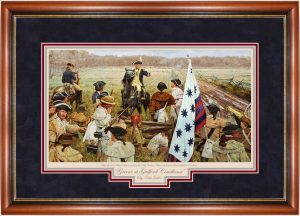
On March 15, 1781, Greene positioned approximately 4,400 men along the road leading to Guilford Courthouse in present-day Greensboro, North Carolina. Cornwallis approached with roughly 1,900 British and German troops. Greene possessed the numerical advantage, but much of his force consisted of militia. He therefore arranged the army in three separate defensive lines across successive ridges and wooded ground.
The first line was formed largely by North Carolina militia posted behind a fence at the edge of an open field. Greene needed them to fire into the British advance, slow its momentum, and then withdraw. Virginia militia occupied the second line in the woods, while experienced Continental infantry waited farther back in the third line.
Released in 1989, Dale’s “Greene at Guilford” depicts the American commander instructing the North Carolina militia before the attack. The scene is quiet compared with the fighting to come, yet it shows the structure on which Greene’s entire plan depended. Each line had a purpose, and the battle’s outcome would be measured not simply by possession of the field, but by how much damage the British army absorbed while reaching it.
Three Defensive Lines Across Three Ridges
Greene divided his army into three lines: about 1,500 men in the first, 1,200 in the second, and 1,700 in the third. His design forced Cornwallis to fight a sequence of separate actions rather than strike the full American army at once.
Cornwallis Opens the Battle at Hoskins House
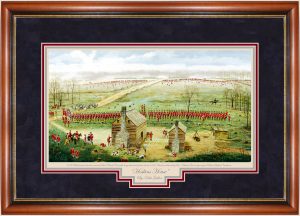
Cornwallis formed his army near the farm of Joseph and Hannah Hoskins. After an artillery exchange, British infantry advanced across the open ground toward Greene’s first line. The North Carolina militia delivered fire from behind the fence, but sections of the line gave way as the redcoats closed with bayonets. The British then entered the woods, where the second American line forced them into a more confused and punishing fight.
Dale’s “Hoskins House,” released in 1986, shows Cornwallis’s troops beginning their assault against Greene’s forward position. The broad composition introduces the scale of the engagement: disciplined British ranks leaving their formation ground and moving toward an American defense that extended far beyond what could be seen from the farm.
The painting is the opening movement in Dale’s three-work Guilford sequence. Commissioned by the Guilford Battleground Company, the series follows the battle from Greene’s preparations, through the British advance, to the violent struggle at the American third line.
The American Third Line Counterattacks
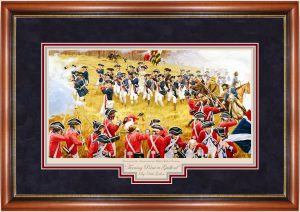
By the time the British reached Greene’s third line, they had crossed open ground, fought through woods, and lost officers and men at every stage. The final American position contained veteran Continental regiments supported by artillery. Here the battle became a series of fierce attacks, counterattacks, cavalry actions, and close-range contests whose direction changed from one portion of the line to another.
Released in 1988, Dale’s “Turning Point at Guilford” depicts an American counterattack at the third line. The painting captures the moment when the British advance, successful against the first two positions, encountered Greene’s strongest troops. The action demonstrates why Guilford Courthouse cannot be understood as a simple British victory. Cornwallis gained the battlefield, but only after a fight that seriously reduced the strength of his army.
Greene ultimately ordered a withdrawal rather than risk destruction. His army remained intact and capable of further campaigning. Cornwallis, although technically master of the field, lacked the strength to pursue. The result reflected Greene’s larger strategy: trade ground when necessary, preserve the American army, and impose losses Britain could not easily replace.
A Victory That Weakened the Victor
Cornwallis held the field at Guilford Courthouse but lost more than one-fourth of his army. The costly result damaged British offensive power and contributed to his decision to leave North Carolina and move toward Virginia.
From Guilford Courthouse to Yorktown
After Guilford Courthouse, Cornwallis marched to Wilmington to rest and resupply before moving into Virginia. Greene turned south again and continued the work of breaking British control in the Carolinas. The two commanders moved in different directions, but the consequences of their North Carolina campaign followed Cornwallis toward the Chesapeake.
In the fall of 1781, Cornwallis established his army at Yorktown, Virginia. Washington and the French commander, the Comte de Rochambeau, moved allied troops south while a French fleet under the Comte de Grasse controlled the Chesapeake. With escape by land and sea blocked, the British position came under siege. Cornwallis surrendered on October 19, 1781, ending the last major land campaign of the war.
The Last Major Battle
American and French forces besieged Cornwallis at Yorktown in the fall of 1781. His surrender on October 19 effectively ended major fighting and secured the American path to independence.
The surrender did not immediately produce a final peace. Negotiations continued until the Treaty of Paris was signed on September 3, 1783. Great Britain recognized the United States as an independent nation and accepted boundaries that extended far beyond the original coastal settlements.
The Revolution left difficult questions unresolved. Americans had declared that liberty and equality were natural rights while slavery continued, Native nations faced intensified pressure on their lands, Loyalists endured confiscation and exile, and the new states still had to create a workable national government. Yet the war permanently altered the Atlantic world. A colonial rebellion had survived military disaster, secured foreign alliance, defeated British armies, and established an independent republic.
Independence Became Official in 1783
The Treaty of Paris, signed on September 3, 1783, formally ended the war. Great Britain accepted American independence and recognized the boundaries of the new United States.
The Revolution Through Dale Gallon’s Art
Dale Gallon’s Revolutionary War collection does not attempt to illustrate every campaign. Instead, these six works bring the viewer close to moments when the outcome remained uncertain: Washington considering the gamble at Trenton, Connecticut farmers facing British regulars, de Fleury inside the works at Stony Point, and Greene’s army absorbing the force of Cornwallis’s attack at Guilford Courthouse.
Together, the paintings show the Revolution at several levels. It was a war directed by generals, fought by professional soldiers, sustained by local militia, strengthened by foreign allies, and endured by civilians whose communities became battlefields. The distance from the frozen Delaware to the wooded ridges of North Carolina was not a straight march toward victory. It was a long contest of survival, adaptation, and resolve.
Explore Dale Gallon’s Revolutionary War Collection
From Washington’s Christmas crossing to the costly struggle at Guilford Courthouse, Dale’s Revolutionary War paintings preserve scenes of leadership, sacrifice, and determination from the fight for American independence.
The collection includes limited edition prints and selected giclée options depicting Trenton, Ridgefield, Stony Point, and the Battle of Guilford Courthouse.