
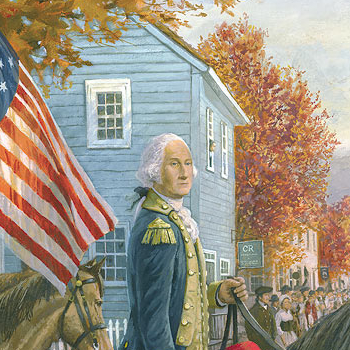
George Washington’s place in American history is almost impossible to separate from the birth of the United States itself. Born on February 22, 1732, at his family’s plantation at Popes Creek in Westmoreland County, Virginia, Washington grew up in the world of colonial Virginia planters, surveying, land ownership, militia service, and imperial conflict. The early death of his father helped shape a young man who was ambitious, disciplined, and deeply aware of reputation, duty, and advancement. Mount Vernon notes that Washington’s formal education was limited compared with many later founders, but he developed practical skills in mathematics, surveying, land management, and military life that shaped his future.
As a young man, Washington became connected to the frontier. His work as a surveyor took him into western lands, and his military service during the French and Indian War gave him experience under pressure long before the Revolution. That service did not make him a flawless battlefield commander, but it gave him something the colonies desperately needed in 1775: a recognizable military figure who could help unite troops from different colonies into one Continental Army. When the Second Continental Congress chose him as commander in chief, Washington became the living symbol of a rebellion that was still fragile, uncertain, and far from victory.
Washington’s importance was not only that he won. It was that he endured. The Revolutionary War demanded patience through disaster, retreat, hunger, disease, short enlistments, political criticism, and military uncertainty. Dale Gallon’s two Washington subjects capture that broader arc beautifully.
Soldier, president, precedent-setter
Washington’s reputation rests not only on battlefield leadership, but on the precedents he set afterward: resigning his military commission, accepting civilian authority, serving as the first president, and voluntarily stepping away from power.
The American Revolution at a Breaking Point
By late 1776, the American Revolution was in serious trouble. The Declaration of Independence had been adopted in July, but declaring independence and surviving independence were two very different things. British and Hessian forces had pushed Washington’s army out of New York, across New Jersey, and into Pennsylvania. The Continental Army was exhausted, battered, short on supplies, and nearing the end of enlistments for many soldiers. If the army dissolved, the Revolution could collapse with it.
The National Park Service summarizes the moment clearly: in December 1776 and January 1777, Washington made a bold move by sending troops into New Jersey on Christmas night, surprising German troops fighting for Britain at Trenton on December 26, and then winning another victory at Princeton on January 3. Those victories revived hopes that the war could still be won.
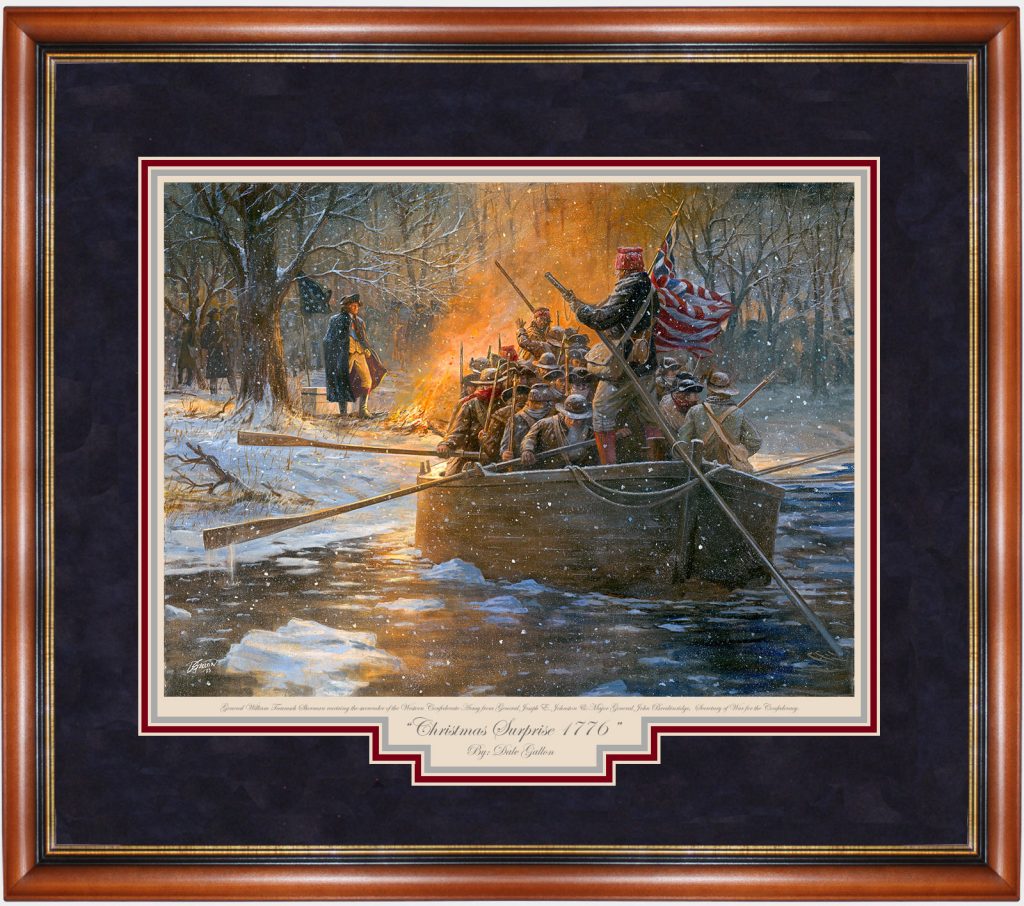
This is the desperate world behind Dale Gallon’s “Christmas Surprise 1776 Washington before Trenton.” The painting is not focused on the popular heroic pose of Washington standing in a boat; instead, it leans into the tension, planning, weather, logistics, and uncertainty of the actual operation.
Christmas Night 1776: The Decision Before the Crossing
Washington’s plan was dangerous because almost everything about it depended on timing. His forces needed to cross the icy Delaware River at night, march through freezing weather, approach Trenton before the enemy could properly react, and strike fast enough to make surprise matter. Mount Vernon notes that Washington and the Continental Army crossed the Delaware River on December 25–26, 1776, as part of the Trenton-Princeton campaign.
Washington originally planned a broader operation with multiple crossings. The National Museum of the United States Army explains that around 2,400 soldiers under Washington’s personal command crossed and moved toward Trenton in two columns. Other planned forces were intended to cross elsewhere and support the operation, but ice, weather, and the river itself prevented parts of the plan from unfolding as Washington hoped.
That failure could have ruined everything. Instead, Washington pushed forward with the force he had. The crossing was not a clean, staged, ceremonial moment. It was a brutal movement of men, horses, artillery, ammunition, and equipment across a winter river in darkness and bad weather. The American Battlefield Trust describes the crossing as taking place in a “treacherous storm,” followed by Washington’s army defeating the Hessian garrison at Trenton the next morning.
The Revolution needed a win
By Christmas 1776, Washington’s army had suffered major setbacks in New York and New Jersey. The attack on Trenton was not just bold — it was born from necessity.
Boats, Weather, and the Reality Behind the Legend
One reason the crossing remains so famous is because of Emanuel Leutze’s 1851 painting, “Washington Crossing the Delaware.” It is dramatic, iconic, and unforgettable, but it is not a literal documentary image of the event. The Metropolitan Museum of Art identifies Leutze’s painting as an 1851 work, created decades after the event it depicts.
The real crossing was far darker, colder, and more practical. The American Battlefield Trust explains that most of Washington’s force was carried across in Durham boats: strong, shallow-draft cargo vessels often used to move iron ore along the river. Heavy artillery and horses were taken across on flat-bottomed ferries. The operation depended heavily on experienced sailors from Colonel John Glover’s Marblehead regiment, aided by local watermen familiar with that section of the Delaware.
That logistical reality is exactly the kind of historical detail that makes “Christmas Surprise 1776” stand apart. Dale’s work emphasizes a more grounded version of the scene: night, bad weather, military calculation, and the practical challenge of getting an army across the river before an attack.
The Battle of Trenton
On the morning of December 26, 1776, Washington’s force reached Trenton and attacked the Hessian garrison. The American Battlefield Trust describes Trenton as a victory in which Washington’s army defeated Hessian mercenaries after crossing the Delaware in a storm. The result boosted American morale and set the stage for another victory at Princeton a week later.
Dale’s “Christmas Surprise 1776 Washington before Trenton” belongs before the battle section visually because it captures the moment before action: the pause before the gamble, the mental burden before the movement, and the human side of a decision that later became legend.
A victory larger than its size
Trenton was not one of the largest battles of the Revolution, but it arrived at exactly the moment Washington’s army and the American cause needed a sign of life.
From Trenton to Princeton
The success at Trenton did not stand alone. Washington followed it with the Battle of Princeton on January 3, 1777. The National Park Service notes that after Trenton, the patriots achieved a similar victory at Princeton, reviving hopes that the war might be winnable. Afterward, Washington’s army encamped for the winter at Morristown, New Jersey.
Washington’s leadership in this period helped define the kind of commander he would be remembered as: not invincible, not untouched by failure, but persistent. He understood that keeping an army together was itself a form of victory. He survived the dark months, found opportunity in crisis, and forced the enemy to respect an army they had nearly written off.
Washington After the Revolution
After the Revolutionary War, Washington made one of the most important decisions of his life: he gave up power. On December 23, 1783, he resigned his military commission before Congress in Annapolis. Mount Vernon describes the resignation as marking the end of Washington’s tenure as commander in chief and his desire to return to Mount Vernon as a private citizen. The U.S. House history office calls the resignation one of the nation’s great acts of statesmanship.
In 1789, Washington became the first president under the Constitution. Everything he did carried precedent. There was no long American tradition of presidential conduct to follow. Washington had to define what the office meant, how it should appear, when it should show restraint, and when it had to act.
The Whiskey Rebellion Begins
The Whiskey Rebellion grew out of a federal excise tax on distilled spirits passed in 1791. Mount Vernon explains that the United States was dealing with significant debt from the Revolutionary War, and Secretary of the Treasury Alexander Hamilton supported the excise tax as part of a broader financial plan. In western Pennsylvania, many farmers viewed the tax as unfair and burdensome. Whiskey was not simply a luxury product there; it was often a practical way to turn grain into something easier to transport and sell.
Resistance to the tax became more than ordinary complaint. In western Pennsylvania, federal tax collectors faced intimidation, threats, and violence. Mount Vernon describes the Whiskey Rebellion as a crisis that tested Washington as president and tested the sovereignty of the Constitution itself.
A test for the new Constitution
The Whiskey Rebellion was not only about a tax. It tested whether the new federal government had the authority and practical ability to enforce laws under the Constitution.
Washington’s Response: Law, Warning, and Force
Washington did not immediately rush into military action. He issued proclamations, sent commissioners, and attempted to separate ordinary political protest from armed resistance. Mount Vernon’s September 25, 1794 proclamation resource notes that Washington’s proclamation came during the height of the Whiskey Rebellion and that the rebellion dispersed shortly after Washington led the militia to Pennsylvania.
The federal government also prepared overwhelming force. The Alcohol and Tobacco Tax and Trade Bureau, a bureau of the U.S. Department of the Treasury, explains that nearly 13,000 militiamen gathered at Carlisle, Pennsylvania, to march west and end the rebellion. It also notes that Washington became the only sitting U.S. president to personally lead troops in the field.
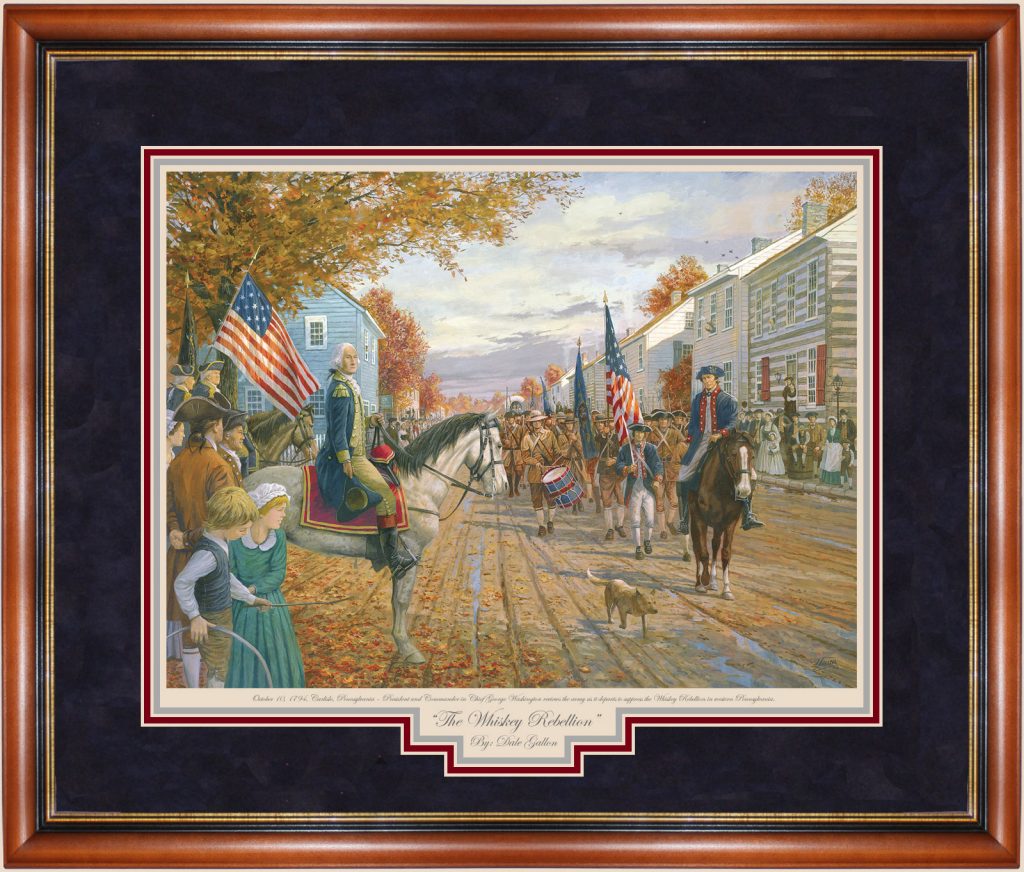
Washington at Carlisle — October 1794
Carlisle, Pennsylvania, became one of the key gathering points for the militia force. Carlisle Borough’s own history notes that in October 1794, George Washington and thousands of militiamen met at Carlisle Barracks on their way to put an end to the rebellion.
Dale Gallon’s “Washington at Carlisle” illustrates this moment in Washington’s presidency. The work shows President and Commander in Chief George Washington reviewing the army as it departs to suppress the Whiskey Rebellion in western Pennsylvania. The piece was released in 2008.
This scene is powerful because Washington is no longer the rebel commander of 1776. In 1794, he is the face of the government. His presence at Carlisle makes the moment feel almost like a mirror image of the Revolution. During the war, Washington fought against what the colonists saw as unjust authority imposed by Britain. During the Whiskey Rebellion, Washington stood for the authority of a government created by Americans themselves.
That distinction matters. Washington did not believe that every protest was rebellion. But he did believe that republican government depended on laws being changed through constitutional means, not destroyed by intimidation and violence. Carlisle became a stage where that principle was made visible.
The March West and the Collapse of Resistance
The militia’s march west was intended to restore order with overwhelming force. Gardner Digital Library’s history of the Whiskey Rebellion in Pennsylvania and Carlisle notes that Washington led the militia out of Carlisle on October 11, and that once the force reached the heart of the rebellion, most opposition fell away.
The rebellion largely collapsed before a major battle occurred. That outcome is important. Washington’s show of force was meant to prevent bloodshed as much as punish resistance. By demonstrating that the federal government had both the will and the capacity to act, Washington helped end the crisis without turning western Pennsylvania into a battlefield.
The Treasury Department’s TTB history of the Whiskey Rebellion describes the event as one of the first tests of the new Constitution and the federal government’s authority. It also states that suppressing the rebellion helped confirm the supremacy of federal law and Congress’s right to levy and collect taxes nationwide.
Dale’s “Washington at Carlisle” captures the moment before that authority moved west. It is not just a military scene. It is a constitutional scene. Washington is president, commander in chief, and symbol of the young republic’s demand that lawful government be respected.
The only sitting president to lead troops in the field
During the Whiskey Rebellion, Washington became the only sitting U.S. president to personally lead troops in the field.
Washington’s Legacy
George Washington died at Mount Vernon on December 14, 1799, but his imprint on American life remains foundational. He helped hold the Continental Army together, supported the creation of a stronger national government, served as the first president, and shaped expectations for the presidency before those expectations were written into law or tradition.
His legacy is not merely that he was first. It is that he understood the danger of being first. Every action could become a model. Every decision could become a precedent. At Trenton, he showed that courage and timing could revive a nearly broken cause. At Carlisle, he showed that a republic must be strong enough to enforce its own laws. In leaving power, he showed that leadership in a republic also means knowing when to step aside.
Dale Gallon’s Washington artwork gives visitors a visual path into that larger story. “Christmas Surprise 1776 Washington before Trenton” presents the burden of command before a decisive Revolutionary War gamble. “Washington at Carlisle” presents the burden of constitutional leadership during one of the first great domestic crises of the United States. Together, they show Washington not as a distant symbol, but as a leader repeatedly tested by the survival of the American experiment.