
July 2, 1863, was the day the Battle of Gettysburg widened. The armies that had collided north and west of town on July 1 now faced one another across a far larger battlefield, stretching from Culp’s Hill and Cemetery Hill south along Cemetery Ridge to the Round Tops, the Wheatfield, Devil’s Den, and the Peach Orchard.
By evening, the fighting would touch nearly every major part of the Union line. It would bring desperate attacks, hurried reinforcements, artillery duels, close-range infantry combat, and decisions made in minutes that shaped the rest of the battle. Day 2 did not produce one single, isolated contest. It became a series of connected crises, each affecting the next.
Previous in the story: Battle of Gettysburg: Day 1
The Union Line Took the Shape of a Fishhook
By July 2, the Union position extended along Cemetery Ridge, curved around Cemetery Hill, and reached Culp’s Hill. Its southern end diminished toward Little and Big Round Top.
A Day of Expanding Battle
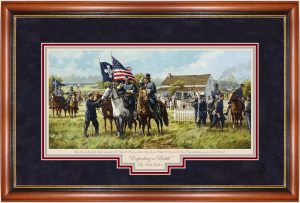
During the night after the first day’s fighting, the main body of the Army of the Potomac arrived at Gettysburg and strengthened the high ground south of town. Major General George G. Meade’s army held a defensive line that was formidable in many places, but it was not complete everywhere. Its shape depended on ridges, roads, stone walls, woods, fields, and the ability of commanders to move men quickly toward danger.
Across the battlefield, the Army of Northern Virginia occupied Seminary Ridge and the ground extending south toward Warfield Ridge. General Robert E. Lee intended to press the Union flanks. Lieutenant General James Longstreet would direct the major Confederate attack against the Union left, while Lieutenant General Richard S. Ewell would threaten the Union right later in the evening.
Dale Gallon’s panoramic “Expecting a Battle” places the viewer near Meade’s headquarters at the Leister Farm. The painting shows Meade speaking with Major General Winfield Scott Hancock as fighting begins on the Union left.
Its title captures the tension of July 2. Meade expected further fighting, but no commander could see the entire battlefield at once. Reports from the left came through aides, couriers, wounded men, artillery fire, and the movement of troops toward the sound of the guns.
The Peach Orchard Changes the Union Left
One of the day’s most consequential decisions came from Major General Daniel Sickles, commander of the Union Third Corps. Rather than remain on the intended Union line along Cemetery Ridge, Sickles advanced his troops westward to the Peach Orchard and along the Emmitsburg Road.
The move placed the Third Corps in a forward position that extended from the area near Devil’s Den toward the Peach Orchard before turning north along the road. It gave Union artillery a more advanced field of fire, but it also created a long, exposed line that would be difficult to support once the Confederate attack began.
A Forward Position at the Peach Orchard
On July 2, Daniel Sickles advanced the Union Third Corps beyond the Federal line on Cemetery Ridge and occupied the Peach Orchard. Confederate attacks forced the corps back at about 6:30 that evening.
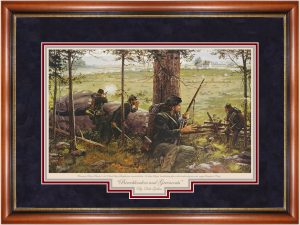
Before the main assault reached the Union line, skirmishers and sharpshooters were already active across the southern part of the field. Dale’s “Breechloaders and Greencoats” depicts men of Hiram Berdan’s 2nd United States Sharpshooters engaging Longstreet’s Corps.
The work draws attention to a part of battle often overlooked in broad maps and sweeping paintings: the men posted ahead of the main lines. Armed with Sharps breechloading rifles and dressed in their recognizable green coats, Berdan’s sharpshooters operated where observation, concealment, and accurate fire could affect the movement of larger formations behind them.
Longstreet’s Assault Begins
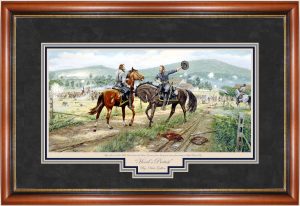
Longstreet’s attack did not begin at dawn. The Confederate movement into position took time, and the assault began late in the afternoon. By then, the Union Third Corps had been exposed in its advanced position, while Little Round Top—the far southern end of the Union line—remained dangerously vulnerable.
“Hood’s Protest” presents Dale Gallon’s interpretation of Major General John Bell Hood conferring with Longstreet shortly before the Confederate advance. The work focuses on the command-level uncertainty that existed before the troops moved forward.
The coming attack would involve Hood’s division on the Confederate right and Major General Lafayette McLaws’s division farther north. Their men would advance against different portions of the Union left, but the ground and the fighting would quickly draw those actions together.
The Attack Opened at 4:00 p.m.
Longstreet’s assaults began from Warfield Ridge at about 4:00 p.m., directed toward Union troops at Devil’s Den, the Wheatfield, the Peach Orchard, and the exposed flank near the Round Tops.
The Wheatfield and the Peach Orchard
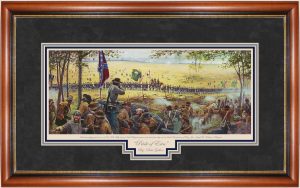
McLaws’s Confederates drove toward the Peach Orchard and the Wheatfield, where the fighting became especially difficult to follow. Units entered the woods and fields, fired at close range, fell back, were replaced, and sometimes returned to ground that had changed hands more than once.
The Wheatfield was not one simple charge or one clean line of battle. It became a crowded, shifting struggle involving Confederate brigades and Union reinforcements from several corps. The men fighting there had little sense of the wider battlefield; they knew only that formations appeared through smoke and trees, that ammunition was running low, and that other troops were giving way nearby.
Dale’s panoramic “Pride of Erin” centers on Colonel Patrick Kelly’s Irish Brigade as its men prepare to fire into Brigadier General Joseph Kershaw’s South Carolinians at close range in the Wheatfield.
The painting narrows the larger battle to a single moment of anticipation. The Irish Brigade had entered a field already marked by earlier fighting, and its men now faced an enemy line at a distance measured in yards rather than maps. It is a reminder that Gettysburg’s broad movements were carried out by soldiers who often encountered one another at frighteningly close range.
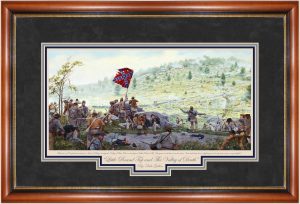
Released in 1992, “Little Round Top and The Valley of Death” offers a wider view of the southern battlefield. Dale’s painting connects Houck’s Ridge, Plum Run, the rough ground below Little Round Top, and the slopes of the hill itself.
That sweep of terrain helps explain why the Day 2 fighting was so hard to control. The battlefield was divided by boulders, woods, fences, ravines, rises in the ground, and narrow passages that separated units from one another. Decisions made at the Peach Orchard could affect troops at the Wheatfield, while events below Little Round Top could threaten the entire Union left.
Warren Sees the Danger at Little Round Top
As Confederate attacks developed across the southern field, Brigadier General Gouverneur K. Warren, the Army of the Potomac’s chief engineer, recognized the danger posed by Little Round Top. The rocky hill overlooked the Union left and offered any force that held it a commanding view of the surrounding ground.
At that point, the summit had only limited protection. Warren understood that Confederate troops moving through the woods and low ground below could seize the hill and threaten the Union army from the flank. His response was immediate: send for troops, get artillery onto the hill, and hold it before the Confederate attack arrived.
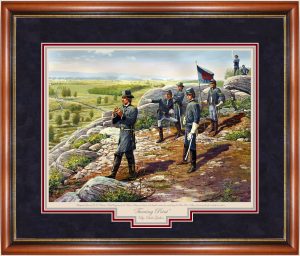
Dale Gallon’s “Turning Point” portrays Warren looking across Plum Run Valley toward the threatened southern end of the field. The title reflects the importance of terrain recognition during the battle. Before soldiers could defend Little Round Top, someone had to recognize that it could not be left unoccupied.
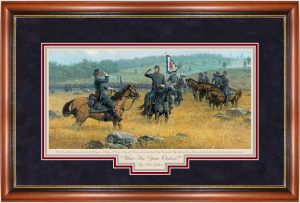
“What are your Orders?” follows the story from Warren’s observation to Colonel Strong Vincent’s brigade. Dale’s painting depicts Vincent meeting a courier near the eastern edge of the Wheatfield as the threat to Little Round Top became clear.
Vincent moved his brigade toward the hill, placing the 16th Michigan, 44th New York, 83rd Pennsylvania, and 20th Maine into a defensive line. Those regiments arrived with little time to spare. Some were still moving into position as Confederate troops pressed upward from the south and west.
A Hill That Could Not Be Left Open
Warren saw that Little Round Top overlooked the Union position and urgently sought reinforcements. Strong Vincent’s brigade, followed by additional troops and artillery, reached the hill in time to defend it.
Artillery, Texans, and the Slopes Below the Hill
The defense of Little Round Top was not solely an infantry fight. Artillery had to be moved up steep, rocky ground under pressure, while Confederate guns answered from positions farther west. Infantry attacks developed through Plum Run Valley and around the boulder-strewn ground below the hill, where formations broke apart and re-formed in the confusion of battle.
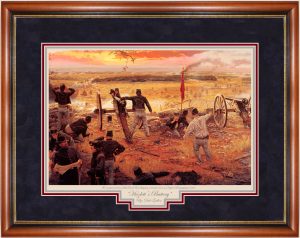
Dale’s “Hazlett’s Battery” shows the view from Little Round Top as the men of Lieutenant Charles Hazlett’s battery fought to help hold the position. The work places artillerymen at the summit, where their guns could support the hard-pressed Union line below.

On the Confederate side, “Reilly’s Battery” turns the viewer toward the guns supporting Hood’s division. Dale’s work presents the artillery contest between Confederate batteries and Hazlett’s Union guns on Little Round Top.
Together, the two paintings show that the hill was not defended from one direction alone. Infantrymen fought among the rocks and trees, while guns on opposing ridges fired across ground filled with smoke, wounded soldiers, and formations that could no longer move as clean lines.
Dale’s panoramic “Texas Pride” follows elements of the 4th and 5th Texas Infantry as they attack toward the extreme left of the Union line. The Texas regiments were part of the larger Confederate effort moving against the Round Tops during Hood’s assault.
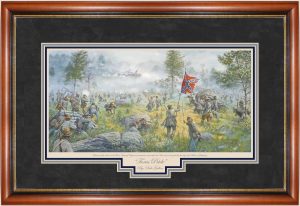
Their advance was made across difficult terrain and against defenders who were arriving, shifting position, or fighting for ground that had been nearly unprotected only minutes earlier. From the Confederate perspective, Little Round Top was an objective that appeared reachable. From the Union perspective, it had become a position that had to be held at any cost.
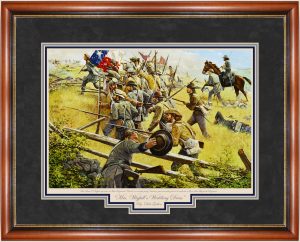
“Wigfall’s Wedding Dress” brings a more personal symbol into the story of the Texas Brigade. Dale’s artwork focuses on the Lone Star flag associated with the 1st Texas and the story behind its creation.
Placed beside the battle scenes of Little Round Top, the work shifts attention from terrain and troop movements to the identities carried into combat by the regiments themselves. Flags served as rallying points, symbols of home, and visual markers that helped men locate their unit in smoke and confusion.
The 20th Maine Holds the Extreme Left

At the far end of Vincent’s line stood Colonel Joshua Lawrence Chamberlain and the 20th Maine. Their position formed the extreme left of the Union army. Should the regiment give way completely, Confederate troops could potentially turn the Union flank and move against the rest of the line.
The 20th Maine faced repeated pressure from Confederate regiments, including the 15th Alabama. The fight was not a single exchange of volleys. The men fired, shifted their line, used the rocks and trees for cover, and fought to keep the regiment from being pushed off the slope.
Dale’s “Hold at All Costs” depicts Chamberlain and the 20th Maine in the defensive role that made the regiment one of Gettysburg’s most remembered units. The title reflects the position’s importance, but it also speaks to the larger responsibility carried by every regiment on Vincent’s line.
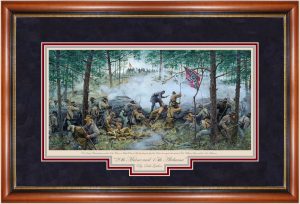
“20th Maine & 15th Alabama” places the two opposing regiments at the center of the action on Little Round Top. Dale’s panoramic composition gives the scene a broader scale than a single portrait of Chamberlain or Oates, emphasizing that the fight involved entire companies and regiments struggling along the rocky slope.
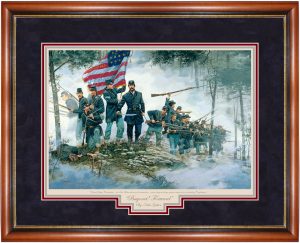
By late afternoon, the 20th Maine was running low on ammunition. Remaining on the defensive risked allowing the Confederates to gather strength for another attempt. Chamberlain chose to move forward.
In “Bayonet! Forward,” Dale depicts the downhill counterattack that helped bring the fighting on the 20th Maine’s front to an end. The charge forced many of the exhausted Confederate attackers back down the slope or into surrender.
The defense of Little Round Top was a combined effort involving Warren, Vincent’s brigade, O’Rorke’s 140th New York, Hazlett’s battery, and many others. Yet the 20th Maine’s final charge became one of the day’s defining moments because it preserved the extreme left of the Union line when its defenders had little room left to give.
The 20th Maine’s Final Charge
The 20th Maine was ordered to the extreme left of the Union line on Little Round Top. Running low on ammunition during its fight with the 15th and 47th Alabama, the regiment fixed bayonets and charged downhill.
A Counterattack Through Plum Run
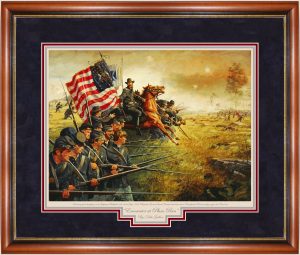
As the Confederate assault lost momentum below Little Round Top, the southern end of the battlefield remained unstable. Union troops had been forced back from several positions, and the ground around Plum Run and the Valley of Death was filled with separated units, wounded men, and formations trying to discover where the line now stood.
Dale’s “Encounter At Plum Run” shows Brigadier General Samuel Crawford leading the Pennsylvania Reserves as evening approached. The work presents the Union effort to close a dangerous opening and push Confederate forces away from the vulnerable ground below Little Round Top.
Crawford’s counterattack did not erase the losses of the afternoon, but it helped stabilize the southern end of the Union position. By the time darkness approached, the Confederates had gained ground in several places, including the Peach Orchard, but they had not broken the Army of the Potomac’s defensive line.
The Crisis at Cemetery Ridge
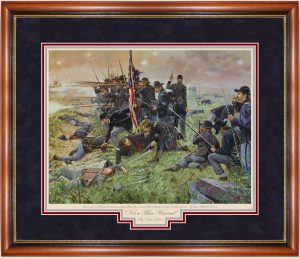
The collapse of Sickles’s forward line created danger farther north on Cemetery Ridge. Confederate brigades moving beyond the Peach Orchard threatened a gap in the Union center-left. Major General Winfield Scott Hancock recognized that the opening could not remain exposed and committed one of the few units immediately available: the 1st Minnesota Infantry.
“Not a Man Wavered” depicts the 1st Minnesota holding its ground against Brigadier General Cadmus Wilcox’s brigade. Dale’s title directs attention to the regiment’s discipline during one of the day’s most costly delaying actions.
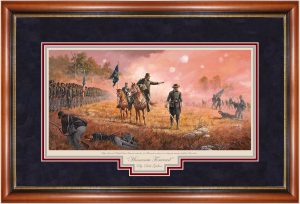
The Minnesotans were not sent forward to win a large stretch of battlefield. They were ordered to stop or slow the Confederate advance long enough for Union troops to restore the line behind them. The regiment charged into a much larger force and paid an extraordinary price for the time it gained.
Dale’s “Minnesota Forward” shows Hancock ordering the regiment ahead near Cemetery Ridge as daylight faded. The work captures the urgency of the command: there was no time to assemble a larger force before the gap could be exploited.
The 1st Minnesota’s attack gave Union commanders the minutes needed to bring reinforcements into position. Its survivors returned to the line having suffered one of the highest casualty rates sustained by a regiment in a single Civil War engagement.
The 1st Minnesota Bought Time at a Terrible Cost
Of the 262 members of the 1st Minnesota present for duty on July 2, only 47 answered the evening roll call. Their charge helped give the Union line time to reform near Cemetery Ridge.
Fighting Continues After Dark
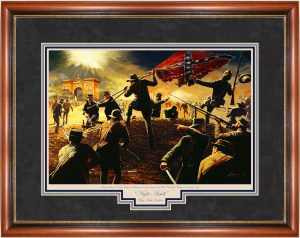
While Longstreet’s attack had raged across the Union left, Ewell’s Confederate corps was preparing attacks against the Union right. Fighting developed at Culp’s Hill and East Cemetery Hill as darkness fell, extending the battle into a new part of the field.
At East Cemetery Hill, Confederate brigades under Harry T. Hays and Isaac Avery struck Union troops at the base of the hill and pushed toward the artillery batteries on its summit. Some Confederate soldiers reached the guns, but Union reinforcements arrived in time to help drive them back.
Dale’s “Night Assault” depicts Hays’s Louisiana brigade amid the artillery on Cemetery Hill. The scene brings the Day 2 story away from the dramatic sunlight of Little Round Top and into the confusion of a nighttime fight where visibility, command, and unit cohesion were all breaking down.
The Confederate attack gained a brief foothold near the guns, but it could not be reinforced or developed into a larger breakthrough. East Cemetery Hill remained in Union hands, just as the Round Tops and Cemetery Ridge had remained in Union hands farther south.
The Assault on East Cemetery Hill Was Repulsed
At dusk, Hays’s and Avery’s brigades attacked East Cemetery Hill. Some Confederates reached the summit and the Union guns there, but reinforcements from the Eleventh and Second Corps helped drive the attack back.
Night Falls on July 2
By the end of the second day, Lee’s army had taken the Peach Orchard and gained ground in the Wheatfield, Devil’s Den, and sections of the southern battlefield. Yet the Confederate attacks had not broken the Union position. Little Round Top remained defended, Cemetery Ridge was still held, East Cemetery Hill had resisted the night assault, and the Union army continued to occupy the high ground.
Meade and his senior commanders met that night at the Leister Farm to consider the army’s position and the possibility of another Confederate attack. The decision was to remain at Gettysburg. Across the lines, Lee also prepared to continue the battle.
Next in the story: Battle of Gettysburg: Day 3 follows the fighting at Culp’s Hill, the artillery bombardment, the Confederate assault against Cemetery Ridge, and the battle’s final major actions.
See the Three Days of Gettysburg in One Framed Work

July 2 showed how quickly the Battle of Gettysburg could expand from one threatened position to another. From the Wheatfield and Peach Orchard to Little Round Top, Cemetery Ridge, and East Cemetery Hill, the day tested the Union line across nearly the entire battlefield.
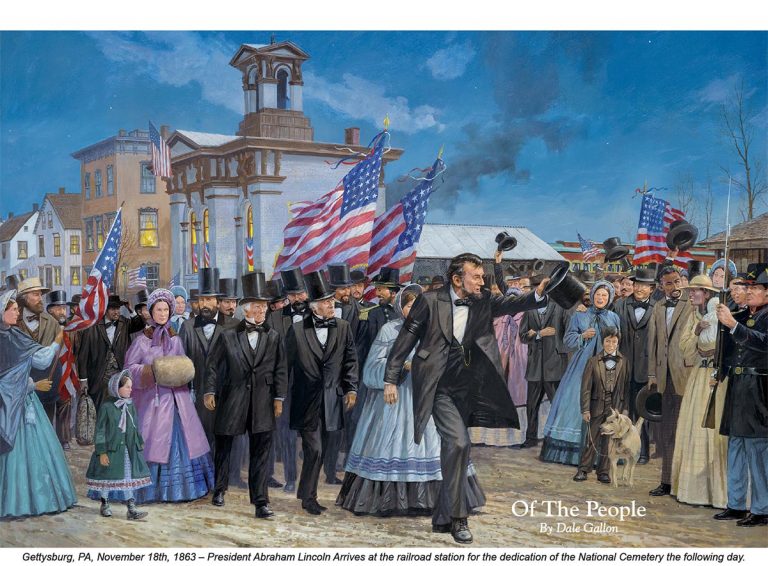
“3 Days of Gettysburg Framed” brings the larger story together in one 41″ x 27″ framed work. The piece presents six mini images: one Union and one Confederate scene from each day of the battle, creating a single visual history of July 1, July 2, and July 3, 1863.
For Gettysburg visitors, Civil War collectors, and anyone who wants to keep the full story together, it is a meaningful way to display Dale Gallon’s interpretation of the battle’s three defining days.