
July 3, 1863, is remembered most often for the Confederate assault against Cemetery Ridge known as Pickett’s Charge. Yet the final day at Gettysburg began long before that advance across open ground. Fighting resumed at dawn on Culp’s Hill, cavalrymen clashed east of town, artillery crews prepared their guns, and commanders on both sides studied a battlefield already scarred by two days of combat.
By afternoon, General Robert E. Lee would commit the Army of Northern Virginia to an attack against the center of the Union line. The result would become Gettysburg’s most recognizable moment, but it was only one part of a larger day of fighting, decision-making, and loss.
Previous in the story: Battle of Gettysburg: Day 2
The Third Day Began on Culp’s Hill
Before sunrise on July 3, fighting resumed on Culp’s Hill. About 22,000 Union and Confederate soldiers battled there for roughly six hours, and three Confederate assaults failed to break the Union line.
The Morning Fight at Culp’s Hill
On the evening of July 2, Confederate troops had gained ground on the lower slopes of Culp’s Hill, threatening the right side of the Union defensive line and the nearby Baltimore Pike. The hill remained a critical position because it anchored the Union army’s right flank and overlooked important roads, supply routes, and approaches to Cemetery Hill.
Before daylight on July 3, the fight began again. Union artillery and infantry struck the Confederate positions, while Southern troops answered with repeated attacks against the Federal earthworks. The battle moved through woods, rocks, breastworks, and ravines where visibility was limited and the opposing lines stood unusually close together.
By late morning, the Confederates had been driven from the ground they had held since the night before. The Union army still possessed Culp’s Hill, preserving the right side of its fishhook-shaped position as the focus of the battle shifted west toward Cemetery Ridge.
Cavalry Fights East of Gettysburg
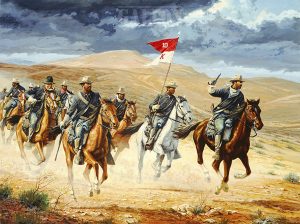
While the infantry battle continued at Culp’s Hill, another important contest developed several miles east of town. Confederate cavalry under Major General J. E. B. Stuart moved toward the Union rear, where Union cavalry under Brigadier General David McMurtrie Gregg and Brigadier General George A. Custer was positioned near the junction of the Hanover and Low Dutch Roads.
The action at East Cavalry Field included mounted charges, artillery fire, close-range fighting, and repeated efforts to gain control of the roads. It unfolded separately from the infantry assault at Cemetery Ridge, but it was tied to the same larger struggle for the Union army’s position and rear.
Stuart Was Stopped East of Town
At East Cavalry Field on July 3, Union cavalry under David Gregg stopped Stuart’s Confederates from turning the Federal flank and threatening the rear of Meade’s army.
The Union Center Becomes the Objective
After the failures against the Union flanks on July 2, Lee turned his attention toward the center of the Federal line. Cemetery Ridge stood opposite Seminary Ridge across a broad stretch of fields, fences, farm lanes, and roads. The Union position was strong, but Lee believed a concentrated artillery bombardment followed by an infantry attack could break through it.
Lieutenant General James Longstreet was assigned to direct the assault. His troops would move from the Confederate line west of Gettysburg toward the Union center, where Major General Winfield Scott Hancock’s Second Corps held an important section of Cemetery Ridge.
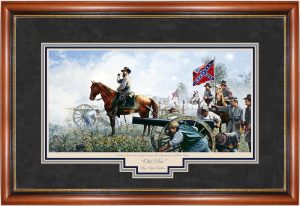
Dale Gallon’s panoramic “Old Pete”, released in 1998, depicts General James Longstreet studying the Union defenses shortly before the attack. The work places the viewer on the Confederate side of the battlefield, where the scale of the open ground ahead made the coming assault impossible to hide.
Longstreet’s position west of Gettysburg was not simply a launching point for an advance. From Seminary Ridge, Confederate officers could see the Union line, but seeing the objective and reaching it were two very different things. The infantry would have to cross exposed fields under artillery and musket fire before reaching the stone walls and guns of Cemetery Ridge.
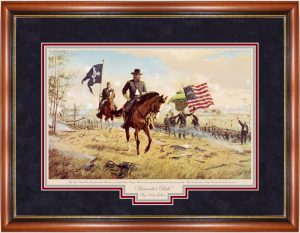
Across the fields, Dale’s “Hancock’s Ride”, released in 1993, shows Major General Winfield Scott Hancock moving along the Federal line before the Confederate attack. The painting presents Hancock as a commander visibly present with the troops who would be asked to hold the ridge.
Hancock’s Second Corps had endured heavy fighting on July 2 and would soon face the central blow of Lee’s Day 3 plan. The Union defenders had time to prepare, but they did not know exactly where the infantry attack would strike or how much of the Confederate army would be committed to it.
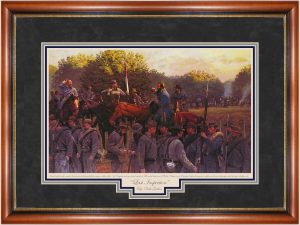
“Last Inspection”, released in 1995, focuses on soldiers of the 11th Virginia before the assault. Dale’s scene includes Pickett, James Kemper, and Lewis Armistead, placing senior commanders near the men who would form part of the famous Virginia division.
The painting also draws attention to the rifle-musket carried by Civil War infantrymen. The weapon gave soldiers far greater effective range than the smoothbore muskets of earlier wars, making an advance across open ground especially dangerous when defenders held prepared positions behind fences, walls, and ridges.
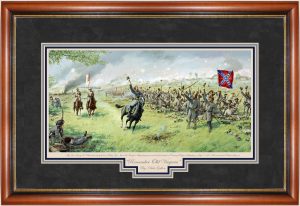
Released in 1992, Dale’s panoramic “Remember Old Virginia” shows Major General George Pickett riding along James Kemper’s brigade before the advance. The painting takes its title from a recollection attributed to Pickett by men who remembered the event after the war.
Rather than presenting that remembered language as a verified battlefield quotation, the work can be understood as Dale’s visual interpretation of the confidence, identity, and expectation surrounding Pickett’s division before it moved forward. The men were preparing for an attack that would later bear Pickett’s name, even though soldiers from other Confederate commands would advance beside them.
Lee Chose the Union Center
On July 3, Lee ordered an attack against the center of the Union line on Cemetery Ridge after the previous day’s fighting had shown the strength of the Union flanks.
The Great Cannonade
At about 1:00 in the afternoon, the Confederate artillery opened fire. Guns along Seminary Ridge and nearby positions sent shells toward Cemetery Ridge, Cemetery Hill, the Union artillery line, and the area around Meade’s headquarters. The bombardment was intended to damage the Federal defenses before the infantry assault began.
Union artillery answered from the ridge. Smoke drifted across the fields, explosions shook the ground, and both armies tried to judge the effect of fire through haze, noise, and incomplete reports. The cannonade was immense, but it did not destroy the Union line as Confederate commanders had hoped.
Nearly 150 Confederate Guns Opened Fire
Before the infantry attack, nearly 150 Confederate cannon bombarded Cemetery Ridge for almost two hours. Between 80 and 100 Union guns responded in one of the war’s largest artillery duels.

Dale’s “Pickett’s Charge — Gettysburg 150th Anniversary”, released in 2013, depicts Lieutenant Alonzo Cushing firing canister at Richard Garnett’s brigade as the Confederate infantry neared the Union line.
The artwork connects the artillery bombardment to the close-range defense that followed. Cushing’s guns had already suffered heavily under Confederate fire, but his battery remained positioned near the Angle, where the infantry attack would soon concentrate.
Across the Open Fields
When the artillery firing began to slacken, Confederate infantry emerged from the woods and ridges west of Gettysburg. The attack is commonly called Pickett’s Charge, but it involved more than Pickett’s Virginians. Troops from Pickett’s division advanced alongside Confederate infantry associated with the commands of James Pettigrew and Isaac Trimble.
Some 12,000 Confederates crossed the open ground toward the Union center. The advance required the men to move over fences, around farm buildings, across the Emmitsburg Road, and through fields swept by artillery, rifle fire, and attacks against their flanks.
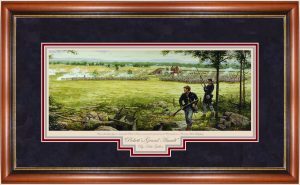
Released in 1986, “Pickett’s Grand Assault” presents the opening movement of Pickett’s division as Union skirmishers withdraw toward the main defensive line. Dale’s panorama emphasizes the order of the initial advance before the formations were broken by the obstacles and fire ahead.
The artwork also demonstrates why the Union defenders could see the Confederate movement so clearly. The fields between Seminary Ridge and Cemetery Ridge offered little concealment. As the Confederates moved east, Federal artillery and infantry had an increasingly direct view of the approaching lines.
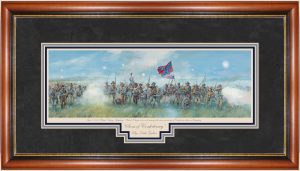
Dale’s 2006 work “Sons of the Confederacy” is a tribute to the unnamed Confederate soldiers who took part in the assault. Rather than narrowing the scene to one commander, the painting places attention on the rank-and-file men who continued forward through artillery fire and collapsing formations.
The attack has often been remembered through famous names such as Pickett, Armistead, Garnett, and Kemper. Dale’s work instead recalls that the advance was carried out by thousands of individual soldiers, many of whom left few records beyond their names on muster rolls, casualty lists, and regimental histories.
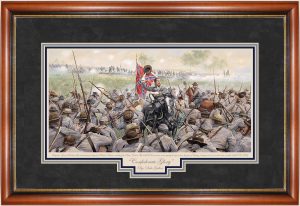
“Confederate Glory”, released in 2001, depicts Brigadier General Richard Garnett leading his brigade toward the Union center. The painting places Cushing’s guns, the Copse of Trees, and the Federal infantry line in the distance, showing the landmarks toward which the Confederate assault was converging.
Garnett’s brigade approached one of the most heavily defended parts of Cemetery Ridge. The closer the Confederates came to the stone wall, the more their line was struck by fire from the front and from Union troops positioned to either side of the advancing columns.
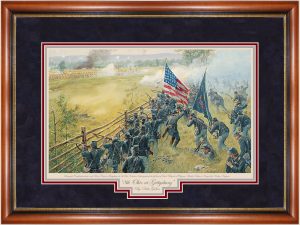
Dale’s “8th Ohio at Gettysburg”, released in 2005, turns attention to a less familiar portion of the assault. The artwork depicts the 8th Ohio Volunteer Infantry attacking the left flank of Joseph Davis’s brigade as Confederate infantry associated with Pettigrew and Trimble moved toward the Union center.
The 8th Ohio’s action illustrates how dangerous the attack became once the Confederate line stretched forward across the fields. The assault was not met only by a wall of fire directly ahead. Union regiments also struck exposed portions of the Confederate advance from the side, adding to the pressure on men already under artillery and musket fire.
The Charge Was a Combined Confederate Assault
Some 12,000 Confederate infantrymen advanced across open fields toward Cemetery Ridge. Although popularly known as Pickett’s Charge, the attack included forces beyond Pickett’s division and failed at a cost of more than 5,000 Confederate casualties in about one hour.
The Union Line Holds at the Angle
As the Confederate infantry neared Cemetery Ridge, the battle became a close-range fight around the stone wall, the Copse of Trees, the Angle, and nearby farm ground. Union troops from several brigades moved to close gaps, reinforce threatened sections of the line, and prevent the attackers from gaining a foothold on the ridge.
The stone wall near the Angle marked a sharp bend in the Union position. It became the center of the fiercest struggle because Confederate troops who reached it had come farther than most of the assaulting force. Their progress, however, could not be reinforced quickly enough to turn a local penetration into a broader breakthrough.
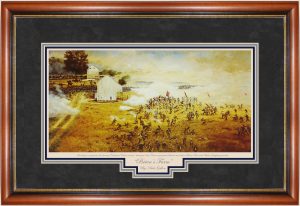
Released in 1986, Dale’s “Brian’s Farm” depicts the moment when Union troops behind a stone wall opened fire on the approaching Confederate column. The work uses the farm ground near the Union center to show how prepared defenders could concentrate fire against men advancing with little cover.
The scene is not simply about a wall or a field. It represents the larger advantage held by the Union position: infantry and artillery were arranged behind defensive terrain, while Confederate troops were forced to continue moving forward under pressure from several directions.
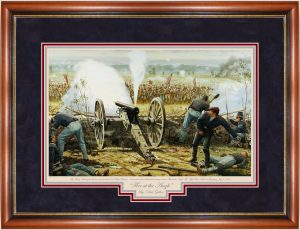
Dale’s “Fire at the Angle”, released in 1988, focuses on Lieutenant Alonzo Cushing at Battery A, 4th United States Artillery. The painting depicts Cushing firing canister as Pickett’s division closed on the guns near the Angle.
Cushing’s battery had been badly damaged during the cannonade. Even after being wounded, he remained at his position and continued directing the defense until he was killed. His stand became one of the most remembered artillery actions of the battle because it occurred at the point where the Confederate advance came closest to breaking the Union center.
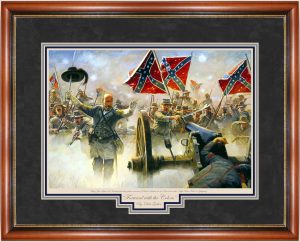
In “Forward with the Colors,” released in 1997, Dale depicts Brigadier General Lewis Armistead leading the remnants of Pickett’s division into the Union line. Armistead’s brigade reached the area around the Angle, where a small number of Confederate soldiers temporarily penetrated the Federal position.
Cushing Remained at His Guns
Battery A, 4th United States Artillery was nearly destroyed during the cannonade. Lieutenant Alonzo Cushing continued directing the defense with his remaining gun until he was killed at his post during the Confederate assault.
The advance was heroic in the literal sense of being carried out under extraordinary danger, but it was also tragic. The Confederate assault had lost too many men during the approach to maintain its momentum, and the small breakthrough near the Angle could not be held against the Union troops converging on it.
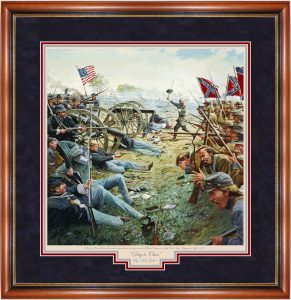
Released in 1990, “Day is Ours” provides another view of Armistead’s final advance near the High Water Mark. Dale’s composition gives the scene its title from the confidence and momentum carried by the men who had come so far across the field.
In historical terms, the moment marked the farthest point reached by the central Confederate attack. Armistead was mortally wounded near the Union guns, and the survivors of his brigade were soon forced back, captured, or killed amid the struggle around the wall and artillery pieces.
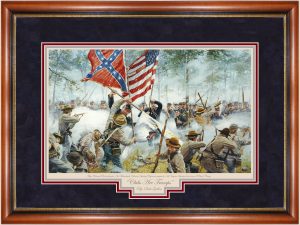
Dale’s “Clubs Are Trumps”, released in 1996, depicts Major Edmund Rice leading the 19th Massachusetts against the 14th Virginia near the Copse of Trees. The title reflects the hand-to-hand intensity that could develop after formal battle lines broke apart at close range.
The painting shows that the final struggle was not decided by one regiment or one battery alone. Union infantry, artillery crews, officers, and reinforcements all converged near the breach, while Confederate survivors tried to press forward, protect their colors, aid wounded comrades, or find a way back across the fields.
The Confederate Breakthrough Could Not Hold
Only one Confederate brigade temporarily reached the crest of Cemetery Ridge during the assault. Union troops closed in around the Angle and forced the surviving attackers back.
After the Assault
Within about an hour, the Confederate attack against Cemetery Ridge had collapsed. Men who had crossed the fields in formation returned in scattered groups, carrying wounded comrades when they could and leaving many others behind. The Union center had held, and there would be no further major Confederate assault at Gettysburg.
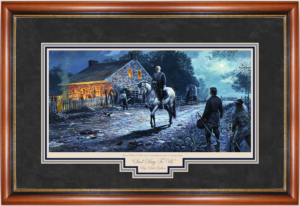
Dale’s “Sad Day to Us,” released in 2000, depicts General Robert E. Lee returning to his headquarters after the day’s fighting. The scene shifts the story away from the smoke at the Angle and toward the command consequences of the failed assault.
Lee’s official report described the severe losses suffered by his army and the reduction of its ammunition as making another attempt to dislodge the Union army inadvisable. The Army of Northern Virginia remained near Gettysburg on July 4, but the campaign had reached its turning point. That night, Lee began the withdrawal toward the Potomac and eventually back to Virginia.
The Major Fighting at Gettysburg Was Over
After the failed July 3 assault, Lee concluded that the losses and ammunition expenditure made another attack inadvisable. The Confederate army began withdrawing from Gettysburg on July 4.
Next in the story: Battle of Gettysburg: After the Battle follows the immediate aftermath, the treatment of thousands of wounded soldiers, the Confederate withdrawal, and Gettysburg’s lasting place in American memory.
See the Three Days of Gettysburg in One Framed Work

July 3 brought the Battle of Gettysburg to its climactic military moment, but the story began with the cavalry and infantry actions of July 1 and expanded across the ridges, fields, and hills of July 2.
“3 Days of Gettysburg Framed” brings the larger story together in one 41″ by 27″ framed work. The piece presents six mini images: one Union and one Confederate scene from each day of the battle, creating a single visual history of July 1, July 2, and July 3, 1863.
For Gettysburg visitors, Civil War collectors, and anyone who wants to keep the full story together, it is a meaningful way to display Dale Gallon’s interpretation of the battle’s three defining days.