

The War of 1812 is sometimes overshadowed by the American Revolution and the Civil War, but it played a major role in shaping the early identity of the United States. Fought between the United States and Great Britain from 1812 to 1815, the war grew out of several tensions: British interference with American trade, the impressment of American sailors into the Royal Navy, disputes over western expansion, and conflict involving Native nations whose lands and sovereignty were threatened by the growing United States. The Library of Congress summarizes the war as a conflict tied to impressment, trade, western expansion, and Native American policy.
The war unfolded while Britain was also fighting Napoleon’s France, which made the Atlantic world a dangerous and complicated place for a young American republic. The National Park Service describes the War of 1812 as part of a broader struggle involving Great Britain, France, the United States, and Native nations, with the United States trying to assert itself in a world still dominated by European empires.
For Americans, the war became a test of survival, sovereignty, and national confidence. The fighting stretched from Canada and the Great Lakes to the Atlantic coast, the Chesapeake Bay, the western frontier, and the Gulf South. Early American hopes for easy victories in Canada were quickly undercut by setbacks, while the U.S. Navy earned important symbolic victories at sea. By 1814, the conflict had entered a dangerous new phase as Britain turned more attention toward the United States after years of war in Europe.
The Chesapeake Campaign and the Road to Fort McHenry
By 1814, the Chesapeake Bay had become one of the most important theaters of the war. British forces raided along the bay, threatened major towns, and eventually captured and burned Washington, D.C. The National Park Service notes that after entering the Chesapeake in the summer of 1814, British forces captured and burned Washington before attempting to subdue Baltimore.
Baltimore was a major target because it was a center of American privateering. American privateers operating from Baltimore had harassed British shipping, making the city both strategically and symbolically important. If the British could take Baltimore after burning Washington, it would deepen the humiliation of the United States and threaten one of the country’s most active ports.
Fort McHenry guarded the water approach to Baltimore. Major George Armistead, the fort’s commander, had prepared for the possibility of attack well before the British arrived. According to the National Park Service, Armistead wanted a flag so large that the British would have no trouble seeing it from a distance. In 1813, he ordered a massive garrison flag measuring 30 by 42 feet, along with a smaller storm flag, from Baltimore flag maker Mary Pickersgill.
A flag made to be seen
Major George Armistead ordered a 30-by-42-foot garrison flag for Fort McHenry because he wanted it large enough for the British to see from a distance.
The Flag is Full of Stars
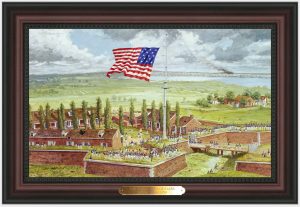
Dale Gallon’s “The Flag is Full of Stars” illustrates Major George Armistead and the defenders of Fort McHenry raising the flag that inspired “The Star-Spangled Banner.” The artwork focuses on Baltimore, Maryland, September 14, 1814, after the British bombardment of Fort McHenry.
The historical moment behind the painting came after a terrifying night. British ships bombarded Fort McHenry for roughly 25 hours on September 13–14, 1814. Despite the attack, the fort held. Francis Scott Key, who witnessed the bombardment and saw the flag still flying over the fort, wrote the words that later became the national anthem.
The Smithsonian records that the original Star-Spangled Banner was made in Baltimore by Mary Pickersgill in 1813, commissioned by Major George Armistead, and originally measured 30 by 42 feet. It had 15 stars and 15 stripes, reflecting the official U.S. flag design from 1795 to 1818. The flag was raised over Fort McHenry on the morning of September 14, 1814, signaling American victory in the defense of Baltimore.
The defense of Fort McHenry became one of the most enduring symbols of the War of 1812. It did not end the war, but it gave the United States a powerful image of survival after the shock of Washington’s burning. Baltimore had been threatened, Fort McHenry had been shelled through the night, and yet the flag still flew in the morning.
The anthem’s battlefield origin
Francis Scott Key wrote the words that became “The Star-Spangled Banner” after witnessing the British bombardment of Fort McHenry and seeing the American flag still flying.
From Baltimore to Peace Negotiations
While Fort McHenry gave the United States a lasting patriotic symbol, the war itself remained unresolved. Peace negotiations were already underway in Europe, and on December 24, 1814, American and British representatives signed the Treaty of Ghent. The National Archives explains that the treaty was signed on December 24, 1814, and ended the War of 1812 between Great Britain and the United States.
The terms of peace were not a sweeping battlefield victory for either side. A National Archives history of the treaty notes that the United States did not “win” the war in the simple sense, but neither did Britain. The agreement largely restored relations to the status quo ante bellum, meaning the prewar state of affairs.
But signing the treaty did not instantly stop fighting. News crossed the Atlantic slowly, and the treaty still required ratification. The National Park Service notes that although the Treaty of Ghent had been signed before the Battle of New Orleans, the war was not officially over until ratification in February 1815.
That delay created one of the strangest and most famous final chapters of the war: the Battle of New Orleans.
The Battle of New Orleans
New Orleans mattered because of geography. The city controlled access to the lower Mississippi River, one of the most important commercial arteries in North America. The National Park Service describes New Orleans as a vital port and the gateway to the Mississippi River Valley; losing it would have placed enormous strain on the American economy.
British forces moved against New Orleans in the winter of 1814–1815. Opposing them was Major General Andrew Jackson, whose army was a mix of regular U.S. troops, militia, volunteers, free men of color, Choctaw allies, and other local defenders. The battle took place on January 8, 1815, at Chalmette Plantation, downriver from New Orleans. The National Park Service states that the British force outnumbered the Americans roughly two-to-one, but Jackson’s troops defeated the attack in about 30 minutes.
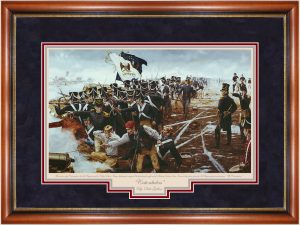
Dale Gallon’s “Cottonbalers,” released in 1998, illustrates the original 7th U.S. Infantry defending the right end of Andrew Jackson’s line. The work connects to the regiment’s nickname, “The Cottonbalers,” which came from this action at New Orleans.
The nickname has a real historical basis. The American Battlefield Trust notes that the 7th U.S. Infantry earned the nickname “The Cottonbalers” from its use of cotton bales as defensive works during the Battle of New Orleans.
The American defensive line at New Orleans was not glamorous, but it was effective. Jackson’s troops fought from prepared positions, using earthworks, mud, and cotton bales as part of the defensive system. British troops launched a forward assault against these defenses and suffered heavy losses. The battle became the greatest American land victory of the War of 1812 and helped turn Andrew Jackson into a national figure.
New Orleans became a national symbol
The American victory at New Orleans was celebrated for decades, with January 8 treated much like a national holiday.
Why New Orleans Mattered After the Treaty
Because the Treaty of Ghent had already been signed, the Battle of New Orleans is sometimes described as unnecessary. That is too simple. The treaty had not yet been ratified, and the soldiers in Louisiana did not know peace had been signed. The fighting was still real, the stakes at New Orleans were still high, and the outcome mattered deeply to how Americans remembered the war.
The victory quickly became a symbol of national pride. The National Park Service notes that the Battle of New Orleans became associated with the idea of American democracy triumphing over old European aristocracy and entitlement, and that January 8 was celebrated for decades as a national holiday similar to the Fourth of July.
That memory also helped shape Andrew Jackson’s public image. His victory at New Orleans raised him to national fame and helped set him on the path to the presidency. The American Battlefield Trust notes that Jackson’s triumph at New Orleans elevated him nationally and contributed to his later rise to the White House.
The Legacy of the War of 1812
The War of 1812 ended without a clear territorial winner, but it left a large imprint on American memory. It gave the United States “The Star-Spangled Banner,” strengthened patriotic feeling, elevated military figures such as Andrew Jackson, and helped convince many Americans that the young republic had survived a second major test against Great Britain.
The war also had deeper consequences beyond American nationalism. Native nations were central to the conflict, and many fought to defend their lands and sovereignty against U.S. expansion. The National Park Service emphasizes that the war involved competing claims for liberty and sovereignty among the United States, Great Britain, and Native nations whose lives and lands were threatened by the North American struggle.
Dale Gallon’s two War of 1812 works give this subject page two strong visual anchors. “The Flag is Full of Stars” captures the symbolic survival of Fort McHenry and the flag that inspired the national anthem. “Cottonbalers” moves the story to New Orleans, where Andrew Jackson’s defensive line and the 7th U.S. Infantry helped produce one of the war’s most famous American victories. Together, the two pieces show how the War of 1812 shaped American memory through both symbol and battle.