
By sunrise on July 1, 1863, the uncertainty that had hung over Gettysburg the day before had become a contest for roads, ridges, and time. Confederate infantry moved east from Cashtown along the Chambersburg Pike, while Brigadier General John Buford’s Union cavalry division held the approaches west and north of town.
What began as a clash between cavalry and an advancing Confederate division quickly drew in infantry, artillery, senior commanders, and eventually entire corps. By nightfall, the Union army had lost Gettysburg itself but retained the high ground south of town. The opening day did not settle the battle, but it determined where the next two days would be fought.
Previous in the story: Battle of Gettysburg: Before the Battle
A Battle of Roads and Ridges
The First Day’s Battlefield stretched north and west of Gettysburg across McPherson Ridge, Oak Ridge, nearby low ground, farms, roads, and the crossing at Willoughby Run.
Buford Holds the Western Approaches
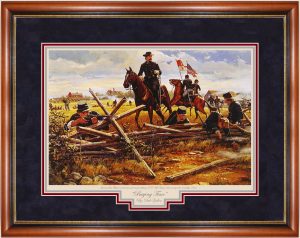
Major General Henry Heth’s Confederate division began moving toward Gettysburg early on July 1. Heth believed he was likely encountering cavalry, perhaps supported by only a limited number of infantry. Buford, however, had spent the previous evening studying the ground and had positioned his troopers to slow the Confederate advance until Union infantry could arrive.
Buford’s cavalry did not fight in the old style of mounted charges. His men dismounted, used fences, ridges, shallow swales, and buildings for cover, and resisted the advance with carbines and artillery support. Their purpose was not to hold every foot of ground; it was to make the approaching Confederates pay for every minute gained.
Dale Gallon’s “Buying Time,” released in 1988, focuses on the mission that defined Buford’s morning. The painting shows Buford and his dismounted troopers resisting the advance of Heth’s division, part of A. P. Hill’s Third Corps. The title captures the practical military value of the cavalry’s stand. Every delay west of Gettysburg gave the Union army a better chance to bring infantry onto the field and prevent the Confederates from taking the town’s commanding ground without opposition.
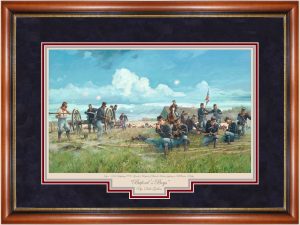
Released in 2013 as part of the Seminary Ridge Museum Series, “Buford’s Boys” places Gamble’s Brigade of Buford’s division in action on McPherson’s Ridge. The location mattered because it stood directly in the path of the Confederate movement from Cashtown toward Gettysburg.
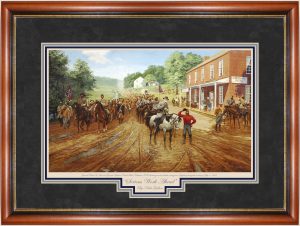
The ridge became the first major defensive line of the day. From there, Union cavalrymen could observe the road, contest the ground west of town, and wait for the sound of friendly infantry moving forward from the south.
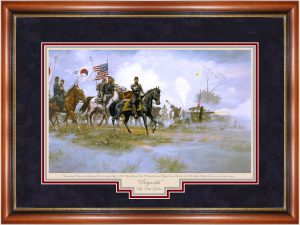
As firing intensified, Confederate leaders began to understand that the encounter ahead was larger than a brief reconnaissance. Dale’s “Serious Work Ahead,” released in 1991, depicts General Robert E. Lee and General A. P. Hill at Cashtown as the sounds of battle reached them from Gettysburg.
The painting marks the moment when a campaign already spread across Pennsylvania narrowed toward one point. Heth’s report later made clear that Confederate commanders had not yet grasped the full size of the Union force near Gettysburg, but the morning’s resistance signaled that the situation was becoming much more serious.
Buford’s Cavalry Bought Time
Union cavalrymen delayed Heth’s Confederate advance for roughly two hours, long enough for the first Union infantry to begin arriving west of Gettysburg.
Reynolds Commits the First Corps
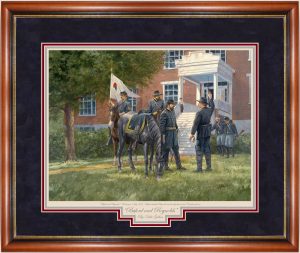
Major General John F. Reynolds, commander of the Union First Corps, was moving north from Emmitsburg when he learned that Buford’s cavalry was heavily engaged. Reynolds reached Gettysburg, met with Buford, and made the decision that transformed the morning skirmish into a major battle: he would commit infantry to the ground west of town.
Reynolds understood that the cavalry could not indefinitely resist Confederate infantry. His First Corps would have to take the pressure from Buford’s troopers, establish a stronger line, and hold the approaches long enough for the rest of the Army of the Potomac to concentrate.
Dale Gallon’s “Buford & Reynolds,” released in 2013, illustrates the meeting between the two generals near the Lutheran Seminary. The work joins the cavalry story to the arrival of the First Corps, showing the handoff from a delaying action to a larger infantry defense.
Buford had identified the importance of the terrain. Reynolds brought the force needed to try to hold it.
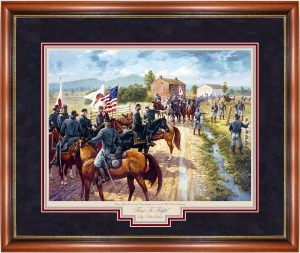
“Time to Fight,” released in 1999, portrays Reynolds on the Emmitsburg Road preparing to commit the First Corps at Gettysburg. Dale’s scene captures the urgency of the decision: the Union army had not planned to make Gettysburg its battlefield, but the battle had come to it.
Once Reynolds sent his infantry into line, there would be no easy withdrawal from the roads and ridges west of town. The First Corps now faced Heth’s Confederates directly, while more men on both sides moved toward the sound of the guns.
Released in 1996, Dale’s “Reynolds” depicts the Union general directing Captain James Hall of the 2nd Maine Light Artillery in the placement of his guns west of Gettysburg. The artwork emphasizes how quickly Reynolds was turning cavalry resistance into a coordinated infantry-and-artillery defense.
That work ended abruptly. While directing troops near the McPherson Farm, Reynolds was killed early in the fighting. His death removed one of the Army of the Potomac’s most respected field commanders at the very moment the battle was expanding.
The Loss of John Reynolds
John Reynolds was killed while leading the First Corps into line on McPherson Ridge. He was the highest-ranking officer on either side to die at Gettysburg.
McPherson Ridge, the Iron Brigade, and the Railroad Cut
With Reynolds gone, command of the First Corps passed to Major General Abner Doubleday. The fight west of town was already severe. Confederate brigades under James Archer and Joseph Davis pressed forward along and on either side of the Chambersburg Pike, while Union troops moved into the woods, fields, and low ground around the McPherson Farm.
Some of the strongest early Union resistance came from the Iron Brigade. Its regiments were thrown into the fighting near Herbst Woods, where they met Archer’s brigade at close range. The action temporarily checked the Confederate push and led to the capture of Archer himself.
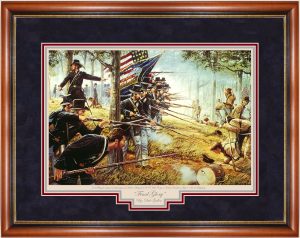
Dale’s “Final Glory,” released in 1990, depicts the Iron Brigade’s attack in Herbst Woods against part of Archer’s brigade. The scene preserves one of the dramatic reversals of the morning, when Union infantry struck back hard enough to disrupt a Confederate advance that had seemed to be gaining momentum.
For a short time, the Union line west of Gettysburg had done exactly what Buford and Reynolds needed it to do: absorb the first blow, counterattack, and keep the Confederates from simply rolling through the town.
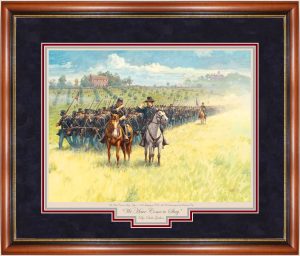
“We Have Come to Stay,” released in 2013, follows the 6th Wisconsin as it advances toward the abandoned railroad cut. The cut had become an unexpected defensive feature, offering Confederate troops a sheltered position near the turnpike.
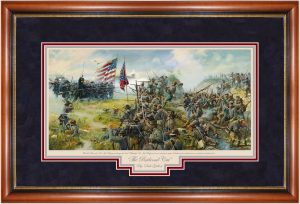
Railroad grades, fences, farm lanes, and shallow depressions shaped the battle in ways commanders could not fully predict from a map. At Gettysburg, a man-made cut through the ground became one of the day’s most contested small pieces of terrain.
Dale’s panoramic “Railroad Cut,” released in 2003, shows the 6th Wisconsin charging Confederate troops in the cut. The scene represents a decisive counterstroke by Union infantry after Confederate troops had pushed forward and used the railroad excavation for protection.
The attack was not made by the 6th Wisconsin alone. The 95th New York and 14th Brooklyn joined the charge, while other Union troops pressed the Confederate position from different angles. The railroad cut was carried, prisoners were taken, and the Union line was temporarily restored.
The Railroad Cut Counterattack
The 6th Wisconsin, 95th New York, and 14th Brooklyn charged the railroad cut, captured two Confederate regiments, and helped relieve the endangered 147th New York.
The Battle Expands North of Town
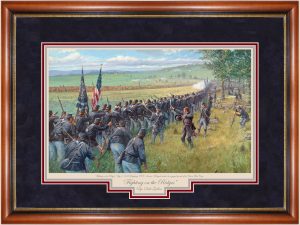
The Union success around McPherson Ridge did not end the danger. Heth’s division reorganized, additional Confederate troops moved up, and the battlefield widened far beyond the Chambersburg Pike. During the afternoon, elements of Lieutenant General Richard Ewell’s Second Corps approached from the north and northeast, bringing new pressure against the Union right.
Major General Robert Rodes’s division moved onto the high ground around Oak Hill and Oak Ridge. Its arrival threatened the right side of the First Corps line, which had already been fighting for hours. The action was no longer centered on one road or one farm. It had become a broad, complicated struggle across ridges north and west of Gettysburg.
Released in 2013, “Fighting on the Ridges” depicts Iverson’s Confederate brigade facing the Union First Corps. Dale’s work brings attention to the less familiar northern fighting, where opposing formations were trying to gain or preserve control of the high ground around Oak Ridge.
Those attacks created a difficult problem for the Federal defenders. The First Corps had to keep facing Confederates west of town while also protecting its exposed northern flank. Its regiments shifted position, changed fronts, and answered attacks from more than one direction.
The Union Line Was Being Stretched
Rodes’s division arrived from the north and formed near Oak Hill, adding fresh Confederate pressure against the right of the Union First Corps.
The Seminary Line Gives Way
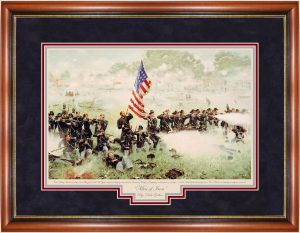
By late afternoon, the First Corps and the recently arrived Eleventh Corps were facing mounting Confederate strength. The Union line west and north of Gettysburg had fought hard, but it could not remain intact indefinitely. Fresh Confederate attacks from several directions gradually forced the Federal troops back toward Seminary Ridge and the town itself.
Withdrawal under fire demanded discipline as well as courage. Units had to hold their ground while neighboring regiments fell back, then retreat before being cut off. Men who had been advancing earlier in the day now found themselves trying to preserve a line that was collapsing around them.
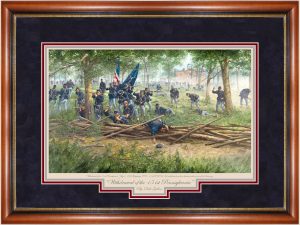
Dale’s “Men of Iron,” released in 1994, focuses on Colonel Henry Morrow and the Iron Brigade’s 24th Michigan during a delaying action back toward Seminary Ridge. In the painting, Morrow carries the flag after the regiment’s color guard has fallen.
The work is not simply about one regiment’s loss. It illustrates the broader problem facing the First Corps: preserve enough cohesion to fall back while continuing to resist a Confederate advance that was becoming stronger by the hour.
“Withdrawal of the 151st Pennsylvania,” released in 2013, shows the Pennsylvania regiment leaving its defensive positions west of the Seminary. The painting places the viewer within one of the day’s most difficult transitions: the moment when soldiers recognized that holding the outer line was no longer possible. The retreat was costly, but it was not meaningless. The delaying actions west of town had allowed more Union troops to reach the area south of Gettysburg, where a new defensive line was beginning to form.
The Federal Line Held Until Afternoon
Union troops west of Gettysburg resisted the Confederate advance for much of the day before being overpowered and driven back toward Cemetery Hill.
Through Gettysburg to Cemetery Hill
As the northern and western Union positions gave way, soldiers from the First and Eleventh Corps withdrew through Gettysburg. The streets, homes, churches, and public buildings of the town became part of the battle. Civilians who had watched the morning’s developments from a distance now found the war moving directly through their community.
Confederate forces entered Gettysburg from the west and north, but the Union army did not simply disappear. Major General Oliver O. Howard helped secure Cemetery Hill south of town, while Major General Winfield Scott Hancock arrived as Meade’s representative and assessed the ground for the arriving army.
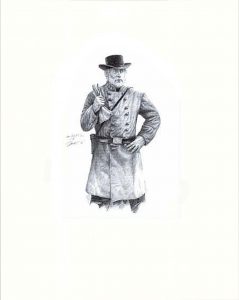
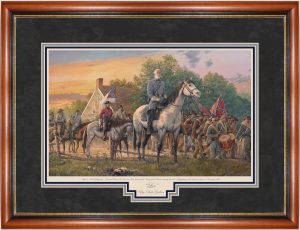
Dale’s “Lee,” released in 2008, portrays General Robert E. Lee observing the Union retreat through Gettysburg toward Cemetery Hill. The work captures the Confederate view at the end of the day: a successful advance had taken the town, but the Union army was gathering on stronger ground just beyond it.
For Lee, the events of July 1 had brought opportunity as well as uncertainty. The Confederates had driven the Union line back, yet they had not destroyed the Army of the Potomac. The larger fight still lay ahead.
Cemetery Hill Became the New Union Anchor
After Reynolds’s death, Oliver O. Howard took command on the field and secured Cemetery Hill. Winfield Scott Hancock soon arrived on Meade’s behalf to take charge of the growing Union position.
Day’s End at the Seminary
The fighting on July 1 left hundreds of wounded men behind the lines that had formed and disappeared during the day. Buildings near the battlefield became places of treatment, shelter, and suffering. Farms, churches, homes, and the Lutheran Seminary itself were drawn into the medical aftermath almost immediately.
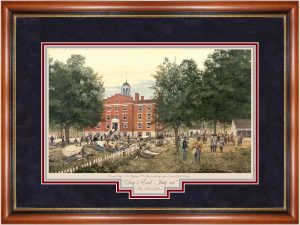
Released in 2013, Dale’s “Day’s End — July 1st” depicts wounded soldiers being treated on the east side of the Seminary. After a page filled with movement, attacks, and retreat, the painting turns attention toward the human cost of the day.
The evening did not bring relief to Gettysburg. It brought the work of caring for the wounded, reorganizing shattered units, moving reinforcements into position, and preparing for another day of battle.
A Night of Decisions
By nightfall, the Union army was consolidating along Cemetery Hill, Cemetery Ridge, and the heights south and east of Gettysburg. The main body of Meade’s army continued arriving during the night, giving the Union a stronger position than it had held at any point during the day.
Lee’s army had won ground, captured prisoners, and pushed the Federal forces from Gettysburg. Yet the Confederate commander now faced a difficult choice: withdraw after a successful first day or continue the fight against an enemy that had established itself on defensible terrain. Lee chose to continue the battle.
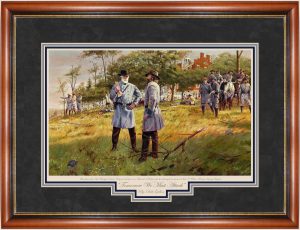
Dale’s “Tomorrow We Must Attack,” released in 1993, portrays Lee and Lieutenant General James Longstreet near the Lutheran Seminary as the day’s fighting comes to an end. The artwork turns from the combat of July 1 toward the decisions that would shape July 2.
Lee’s official report later described the favorable result of the opening day as encouragement to renew the attack. The next morning, both armies would be larger, their lines more firmly established, and the stakes even greater.
The Battle Would Continue
After the July 1 fighting, Lee concluded that the Confederate army should renew the attack. During the night, the main body of the Union army arrived and took up defensive positions around Gettysburg.
Next in the story: Battle of Gettysburg: Day 2 follows the expansion of the battle from Cemetery Hill and Culp’s Hill to the Peach Orchard, Wheatfield, Devil’s Den, and Little Round Top.
Follow the Full Story of Gettysburg

July 1 opened the battle and set the lines that would shape the fighting to come. The next two days would bring the struggle for the Union left, the defense of Cemetery Ridge, and the final Confederate assault.
“3 Days of Gettysburg Framed” brings those defining moments together in one 41″ x 27″ framed work. The piece features six mini images: one Union and one Confederate scene from each day of the battle.
It is a meaningful way to keep Dale Gallon’s visual interpretation of Gettysburg’s full three-day story together in one display.