
When the firing faded on the evening of July 3, 1863, the Battle of Gettysburg had reached its military conclusion. The Union army still held the high ground south and east of town. The Confederate assault against Cemetery Ridge had failed, and General Robert E. Lee now faced the difficult task of withdrawing an army burdened by wounded men, damaged artillery, limited ammunition, and long wagon trains.
July 4 was not a clean ending. Rain fell across the battlefield. The opposing armies remained near one another, thousands of wounded soldiers still needed care, and Gettysburg’s residents faced a town and countryside transformed by three days of fighting. The battle was over, but its consequences had only begun.
Previous in the story: Battle of Gettysburg: Day 3
The Campaign Turns South
On July 4, Lee began the retreat of the Army of Northern Virginia toward Virginia. Severe rain complicated the movement, and the rear of the Confederate column did not leave the Gettysburg area until after daylight on July 5.
A Sad Day for the Army of Northern Virginia
Lee had hoped that the July 3 attack against the Union center might produce the decisive result his campaign needed. Instead, the assault had cost the Army of Northern Virginia thousands of men. In his official report, Lee later explained that the strength of the Union position, the reduction of Confederate ammunition, and the difficulty of obtaining supplies made another major attack too dangerous to attempt.
Before the army could leave Gettysburg, its commanders had to organize the movement of wounded men, weapons recovered from the field, artillery, supply wagons, and the troops needed to protect the retreat. The withdrawal was not a single march at a single moment. It began with preparation on July 4 and continued west through the mountains toward the Potomac River.
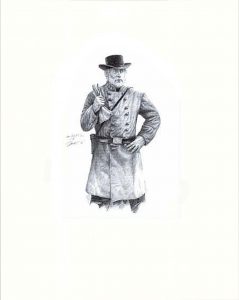
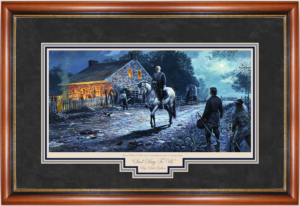
Dale Gallon’s panoramic “Sad Day to Us,” released in 2000, is set at 1:00 a.m. on July 4, 1863. The painting depicts General Robert E. Lee returning to his headquarters after the exhausting third day of battle.
The work is a fitting bridge between the fighting of July 3 and the withdrawal that followed. Rather than showing the open fields of Cemetery Ridge or the close struggle at the Angle, Dale turns toward the burden of command after the result was known. The army Lee had led north into Pennsylvania was still dangerous and intact, but its campaign had changed direction.
Lee Ordered a Withdrawal
Lee wrote that the Union position, the loss of Confederate ammunition, and the difficulty of obtaining supplies made another attack too risky. Wounded soldiers able to travel and arms collected from the field were ordered west toward Williamsport.
A Town of Hospitals and Graves
The armies could move on, but Gettysburg could not. The battle had been fought across farms, orchards, roads, ridges, gardens, and the streets of a town whose residents had little warning that it would become the center of the campaign.
Thousands of wounded Union and Confederate soldiers remained behind. Churches, schools, public buildings, private homes, barns, and farmhouses became temporary hospitals. Residents who had spent the battle sheltering in cellars or fleeing from the fighting returned to find wounded soldiers in their homes, dead horses in their fields, damaged property, and graves scattered across the landscape.
The scale of the suffering made ordinary life impossible. Medical personnel, volunteers, relief organizations, soldiers, and local families worked to feed, shelter, nurse, transport, identify, and bury the men left behind by the battle.
Gettysburg Became a Vast Hospital
When the armies left, more than 51,000 soldiers were dead, wounded, or missing. Wounded and dying men crowded nearly every building, while fields and gardens became burial grounds.
Gettysburg’s civilians were not merely witnesses to the aftermath. Many became caregivers. Local residents helped tend soldiers from both armies, preparing food, washing clothing, nursing injuries, and opening homes and churches to the wounded. Their work continued long after the armies had moved south and the sound of artillery had faded.
One of the many Gettysburg residents drawn into the relief effort was schoolteacher Sallie Myers, who helped care for wounded soldiers at her family’s home and in the Catholic Church before later assisting at Camp Letterman General Hospital east of town. Her experience reflected the work done by local people whose community became part of the war overnight.
The Care Continued for Months
Camp Letterman General Hospital was established east of Gettysburg to care for the wounded. More than 20,000 injured Union and Confederate soldiers passed through its wards before the last patients left in January 1864.
From Battlefield to National Cemetery
The immediate aftermath raised a question that could not be ignored: how should a nation bury and remember the men who had died at Gettysburg? Many of the dead had first been placed in hurried graves near where they fell. In the months that followed, Union soldiers were reinterred in what became the Soldiers’ National Cemetery.
The cemetery transformed part of the battlefield into a place of national mourning. Its creation made Gettysburg more than the site of a major military engagement. It became a place where the losses of the battle could be confronted, named, and remembered.
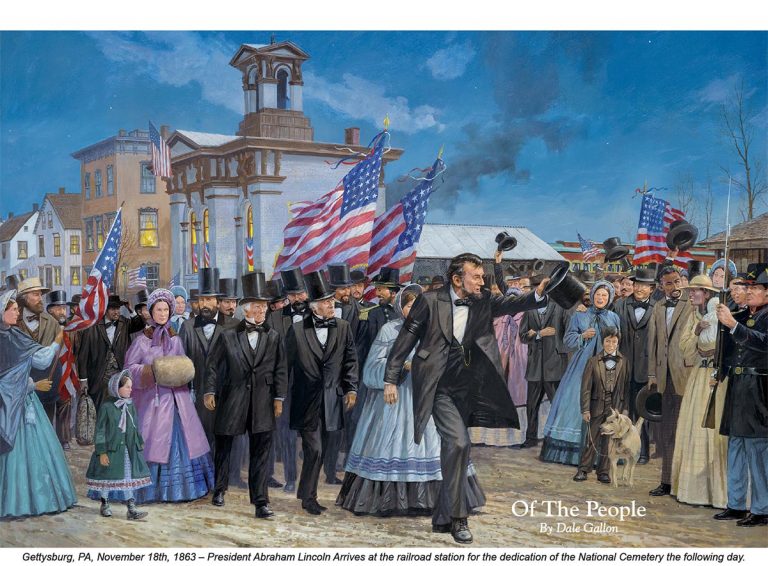
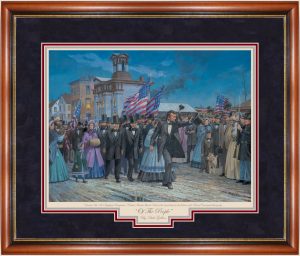
Although set several months after the battle, Dale Gallon’s “Of The People” provides a meaningful final image for the Gettysburg story. Released in 2008, the painting depicts President Abraham Lincoln arriving at the Gettysburg railroad station on November 18, 1863, before the dedication of the Soldiers’ National Cemetery the following day.
The work moves the story from the military events of July to the nation’s effort to understand their meaning. Lincoln’s visit came after months of burial work, medical care, grief, and rebuilding. The cemetery dedication on November 19 gave the nation an opportunity to honor those who had died and to consider what their sacrifice meant for the future of the United States.
Lincoln Returned Gettysburg to the National Story
The Soldiers’ National Cemetery was dedicated on November 19, 1863. At that ceremony, Abraham Lincoln delivered the Gettysburg Address, connecting the sacrifice of the battle to the nation’s continuing struggle for a “new birth of freedom.”
The Battle’s Lasting Meaning
The Battle of Gettysburg ended on July 3, but July 4 began a different chapter. Lee’s army withdrew toward Virginia. The Army of the Potomac remained on the battlefield. Gettysburg’s residents faced the enormous labor of caring for the wounded and burying the dead. Families across North and South waited for news of men who had marched into Pennsylvania and did not return.
Dale Gallon’s Gettysburg artwork follows that full arc: the uncertainty before the battle, the hard fighting of the three days, the exhausted commanders, the soldiers in the ranks, and the legacy that followed. The story is not only about a place on a map. It is about the people whose decisions, courage, loss, and memory made Gettysburg one of the defining events in American history.
Keep the Full Gettysburg Story Together

The Battle of Gettysburg unfolded across three defining days: the opening struggle west of town, the fight for the Union flanks and high ground, and the final Confederate assault against Cemetery Ridge.
“3 Days of Gettysburg Framed” brings that larger story together in one 41″ by 27″ framed work. The piece features six mini images: one Union and one Confederate scene from each day of the battle.
It is a meaningful way to display Dale Gallon’s visual interpretation of Gettysburg’s full three-day story and the events that continue to make the battlefield matter.