
The Buffalo Soldiers were among the most important and often under-recognized soldiers in United States military history. After the Civil War, Congress and the U.S. Army created Black Regular Army units at a time when the country was still struggling through reconstruction, segregation, and the uncertain future of formerly enslaved people. In 1866, the Army formed the 9th and 10th Cavalry and the 24th and 25th Infantry regiments, replacing the temporary U.S. Colored Troops with permanent Black Regular Army units. Many of the men who enlisted were Civil War veterans, formerly enslaved men, or Black Americans seeking work, security, and dignity in a country that still denied them equal citizenship.
The name “Buffalo Soldiers” has more than one origin story. The Smithsonian’s National Museum of African American History and Culture notes that one explanation connects the nickname to the soldiers’ dark, curly hair resembling buffalo fur, while another connects it to the courage and fighting spirit Native warriors saw in them. Over time, the name became tied especially to the 9th and 10th Cavalry, then more broadly to Black soldiers who served in the segregated U.S. Army.
Their story is full of contradictions. Buffalo Soldiers served with discipline and courage in an Army that still segregated them and often failed to properly recognize their achievements. They protected mail routes, built roads and telegraph lines, scouted difficult terrain, served in campaigns across the West, fought in Cuba during the Spanish-American War, and later became some of the earliest protectors of national parks. At the same time, their frontier service was part of the larger expansion of the United States into Indigenous homelands, a history that should be told honestly rather than flattened into simple hero worship.
Dale Gallon’s Buffalo Soldier Series follows that long arc: from the hard fighting and survival of the western frontier, to the story of Henry O. Flipper, to the campaigns against Victorio and Geronimo, and finally to the Spanish-American War, where Buffalo Soldiers helped win ground in Cuba and challenged the myth that only Theodore Roosevelt’s Rough Riders carried the day.
Wagonmaster Fight and the Battle at Milk Creek
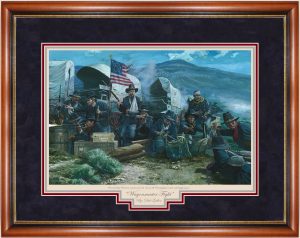
A strong place to begin this story is “Wagonmaster Fight,” because it shows the Buffalo Soldiers not as background figures, but as men under extreme pressure in a brutal frontier fight. Dale’s work, released in 2002, illustrates the fighting near present-day Meeker, Colorado, in September and October 1879, with units from the 3rd, 5th, and 9th Cavalry fighting from circled supply wagons while surrounded during the battle connected to Milk Creek.
The historical setting was the Ute conflict of 1879, often connected with the White River Agency and the Battle of Milk Creek. U.S. troops under Major Thomas Thornburgh were moving toward the White River Agency when they were attacked near Milk Creek. The fighting became a desperate defensive stand, with soldiers and wagonmasters holding out from behind wagons, dead animals, and improvised cover while waiting for relief. This was not a clean battlefield line or a ceremonial cavalry charge. It was survival under fire.
One of the key Buffalo Soldier figures connected to this action was Sergeant Henry Johnson of Company D, 9th U.S. Cavalry. The National Park Service records that Johnson later received the Medal of Honor for his actions at Milk River, and the Congressional Medal of Honor Society lists his action date as October 2, 1879, at Milk River, Colorado. His citation credits him with leaving fortified shelter under close-range fire to check the guard positions and then fighting his way to the creek and back to bring water to the wounded.
That detail gives “Wagonmaster Fight” its emotional weight. The painting is not only about men firing from wagons. It is about the exhausting, practical, terrifying work of keeping wounded men alive while pinned down. It also introduces one of the major themes of the Buffalo Soldiers’ history: Black enlisted men repeatedly performed dangerous, disciplined service while the nation they served continued to deny them full equality.
Medal of Honor under fire
Sergeant Henry Johnson of the 9th U.S. Cavalry received the Medal of Honor for actions at Milk River, Colorado, where he left shelter under heavy fire and helped bring water to the wounded.
Henry O. Flipper and the Burden of Firsts
From Sergeant Johnson’s action at Milk Creek, the story naturally moves to another kind of courage: the burden placed on Henry O. Flipper. Born enslaved in Thomasville, Georgia, on March 21, 1856, Flipper entered the U.S. Military Academy in 1873 and became the first African American graduate of West Point in 1877. He was commissioned as a second lieutenant and assigned to the 10th Cavalry, one of the Buffalo Soldier regiments.
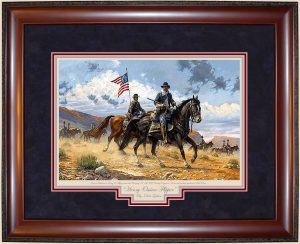
Dale Gallon’s “Henry O. Flipper,” released in 2000, illustrates Second Lieutenant Flipper scouting with Company A, 10th U.S. Cavalry, near the Rio Grande River in Texas in 1880.
Flipper’s presence in this page matters because his story expands the Buffalo Soldier narrative beyond enlisted service. He represented a breakthrough, but also the unfair isolation that often came with being first. The U.S. Army Center of Military History notes that from 1878 to 1880 Flipper served on frontier duty in the Southwest, with responsibilities including scouting, engineering, surveying, construction supervision, adjutant duties, quartermaster work, and commissary duties.
His later career also shows the racism built into the institution around him. In 1881, Flipper was accused of embezzlement and conduct unbecoming an officer. He was acquitted of embezzlement but convicted of conduct unbecoming and dismissed from the Army in 1882. More than a century later, President Bill Clinton posthumously pardoned him on February 19, 1999.
Placed after “Wagonmaster Fight,” Flipper’s story gives the page a powerful transition: the Buffalo Soldiers were not only fighting battles on the frontier. They were also fighting for recognition, rank, fairness, and the right to be judged by the same standards as white soldiers.
First Black graduate of West Point
Henry O. Flipper graduated from the U.S. Military Academy in 1877 and was commissioned into the 10th Cavalry, becoming a landmark figure in Buffalo Soldier history.
Midnight Hour and the Victorio Campaign
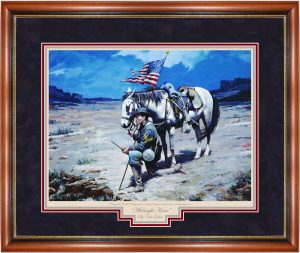
The year 1880 connects Flipper’s frontier service with another Gallon piece: “Midnight Hour.” Dale’s 1996 work illustrates a trooper of the 9th U.S. Cavalry in south-central New Mexico Territory during the Victorio Campaign, waiting to be relieved of his guidon and horse before a midnight deployment.
The Victorio Campaign was part of the long and difficult Apache Wars in the Southwest. Victorio, a leader of the Warm Springs Apache, resisted forced removal and fought across New Mexico, Texas, and northern Mexico. The campaign demanded exactly the kind of work Buffalo Soldiers were often assigned: long patrols, rough terrain, dangerous night movement, scouting, tracking, and endurance far from comfortable supply lines.
The National Park Service notes that the 10th Cavalry played a major role in the 1879–1880 campaign against Victorio. Colonel Benjamin Grierson attempted to prevent Victorio from reentering Texas and especially from reaching New Mexico, where he might find more support. The campaign became the largest military concentration ever assembled in the Trans-Pecos region, with major confrontations at Tinaja de las Palmas and Rattlesnake Springs helping force Victorio back into Mexico.
“Midnight Hour” gives this broader campaign a quieter human focus. Instead of showing a named commander or a climactic charge, it pauses on a single trooper waiting in the dark before deployment. That makes the piece a useful bridge in the page: from Flipper’s individual story to the larger, grueling work of the 9th and 10th Cavalry across the Southwest.
This is where the Buffalo Soldiers’ reputation for endurance becomes clear. Their work was often less cinematic than later legend suggests. It meant riding in heat, cold, darkness, dust, and uncertainty; guarding routes; protecting supplies; and moving through country where a mistake could be deadly.
The Tenth Horse and the Geronimo Campaign
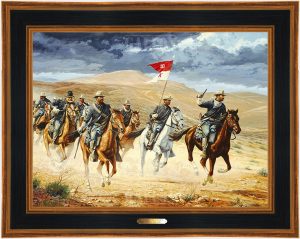
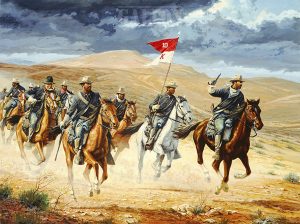
By 1886, the focus shifts from Victorio to Geronimo. Dale Gallon’s “The Tenth Horse,” released in 1997, illustrates Troop K, 10th U.S. Cavalry, picking up the trail in the Santa Cruz Valley of Arizona Territory during the Geronimo Campaign in the spring of 1886.
The U.S. Army Center of Military History records that the 10th Cavalry moved from Texas to Arizona in the spring of 1885. When the Geronimo campaign began, a battalion made up of Troops D, E, H, and K was sent from Fort Grant in search of Apache fighters, and much of the regiment remained in the field during the campaign.
That history makes “The Tenth Horse” an excellent continuation from “Midnight Hour.” The story moves from the 9th Cavalry in the Victorio Campaign to Troop K of the 10th Cavalry in the Geronimo Campaign, but the demands are familiar: movement, patience, tracking, and readiness. These were not isolated moments. They were part of years of frontier service in which Buffalo Soldiers became deeply associated with cavalry work in the Southwest.
The phrase “picks up the trail” is important because it captures the nature of the campaign. Much of this warfare was not fought as set-piece battles. It was pursuit, reconnaissance, reading terrain, locating water, following tracks, and trying to anticipate where a smaller, highly mobile group would move next. The soldier in the saddle was not simply muscle; he was part of the Army’s eyes, ears, and endurance.
Dress on the Colors and San Juan Heights
The final artwork in this story moves the Buffalo Soldiers out of the American West and into the Spanish-American War. Dale Gallon’s “Dress on the Colors,” released in 1988 and originally commissioned by the U.S. Army War College in Carlisle, Pennsylvania, illustrates Acting Color Sergeant George Berry of Troop G, 10th U.S. Cavalry, carrying the national flag of his own command along with the standard of the 3rd U.S. Cavalry during the assault at Kettle Hill, San Juan Heights, Cuba, on July 1, 1898.
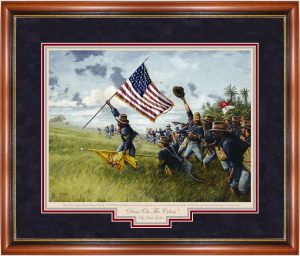
This is a crucial moment because Buffalo Soldiers were central to the fighting in Cuba, even though popular memory often gives most of the attention to Theodore Roosevelt and the Rough Riders. The National Museum of the United States Army states that the 10th Cavalry and the 24th Infantry helped lead the final charge to San Juan and Kettle Hills. It also notes that Sergeant George Berry carried both the 10th and 3rd Cavalry battle flags to the summit, and that the 10th Cavalry lost 20 percent of its fighting force while becoming the only unit to assault both high points in the San Juan Heights.
That makes “Dress on the Colors” a fitting climax for the page. The earlier pieces show Buffalo Soldiers in frontier campaigns, scouting duty, midnight deployments, and hard pursuit. This final piece shows them in a highly visible battlefield moment on foreign soil, serving under the same flag while still living under segregation at home.
The symbolism is sharp: George Berry carrying two flags up the heights becomes more than a battlefield detail. It represents the double burden Buffalo Soldiers carried throughout their history. They fought for the United States while also fighting to prove their own worth to a country that should not have needed convincing.
More than the Rough Riders
At San Juan Heights, the 10th Cavalry played a major role in the assault, and Sergeant George Berry carried both the 10th and 3rd Cavalry battle flags to the summit.
The Legacy of the Buffalo Soldiers
The legacy of the Buffalo Soldiers is not simple, and that is exactly why it is important. They served with courage in a segregated Army. They helped build and protect parts of the American West while also participating in campaigns tied to the displacement of Indigenous peoples. They proved themselves in the frontier Army, in Cuba, and later in other assignments, even while racism shaped how they were treated, promoted, remembered, and written about.
Their record was extraordinary. The National Museum of the United States Army notes that Black soldiers in these regiments earned Medals of Honor for valor in combat and took part in major operations on the western frontier. The National Park Service also highlights that Buffalo Soldiers later served as some of the first rangers in America’s national parks, helping protect public lands before the creation of the National Park Service itself.
Dale Gallon’s Buffalo Soldier Series gives this history a visual path. “Wagonmaster Fight” begins with survival and sacrifice at Milk Creek. “Henry O. Flipper” introduces the lonely breakthrough of the first Black West Point graduate. “Midnight Hour” shows the watchful tension of campaign life. “The Tenth Horse” follows the 10th Cavalry into the Geronimo Campaign. “Dress on the Colors” brings the story to Cuba, where Buffalo Soldiers helped carry the fight up San Juan Heights.
Together, these works tell a story of service, endurance, contradiction, and honor. The Buffalo Soldiers helped shape the U.S. Army and left a legacy that reaches beyond the frontier posts and battlefields where they served. Their story belongs not only to military history, but to the larger American struggle over citizenship, equality, memory, and recognition.